The usual advice for putting modern equipment into a traditional room is to hide it. That advice is sound, and it has a ceiling. A room in which every object made after 1950 has been disguised stops feeling historic and starts feeling like a set, and the disguises themselves become the thing you notice.
The working principle
- Match honesty of manufacture, not period. A precise modern object and a hand-cut antique belong together.
- Everything done to an antique should be reversible. Clamp, do not screw. This is a conservation rule, and it is the right one here too.
- Colour and finish, not concealment, do most of the reconciling between the two centuries.
- Lighting is the one modern technology that unambiguously improves an old room, provided the numbers are right.
Match the honesty of the making, not the date
Two objects sit together when neither is lying about its origin. That is the whole of it. A Georgian chest and a machined aluminium speaker can share a wall because both display their construction: dovetails on one, tolerances on the other. Put a vinyl-wrapped cabinet imitating oak between them and the room falls apart, because the eye reads the imitation instantly and then distrusts everything nearby.
This is roughly what the trade calls transitional design, and it is more disciplined than the word suggests. Transitional does not mean half old and half new spread evenly. It means one clear structural language, usually the traditional one supplied by the building, with modern pieces introduced as deliberate punctuation rather than as filler.
Furniture is the joint between the two worlds
A traditional room absorbs technology best through furniture that was already designed to hold things. A writing desk takes a laptop. A linen press takes a router and the accumulated cabling of a household. A sideboard takes speakers. The difficulty is doing it without damaging the piece.
Three constraints matter, and none of them appears in the styling articles.
- Reversibility. Cable ports, brackets and mounts should clamp, rest or sit in existing openings. Drilling a hole through the back of an eighteenth-century case for a power lead removes value that cannot be put back.
- Heat. Equipment inside a closed cabinet needs an air path. An amplifier in a sealed cupboard cooks itself and dries the timber immediately around it.
- Humidity. Wood moves with the moisture in the air. The Canadian Conservation Institute’s guidance on furniture and wooden objects stresses keeping relative humidity stable rather than hitting one perfect number, with figures around 55% and 18 to 25 degrees commonly quoted for fine furniture. What actually breaks joints and lifts veneer is a rapid swing, which is exactly what a dehumidifier or a heat pump running on an aggressive schedule can produce.
Colour does the reconciling that concealment cannot
Traditional interiors run on saturated, pigment-heavy colour: the deep greens, ox-blood reds and ochres that came out of the pigments available at the time. Contemporary equipment arrives in graphite, white and brushed metal. Those two families do not clash, but they need a mediator, and it is almost always the wall finish.
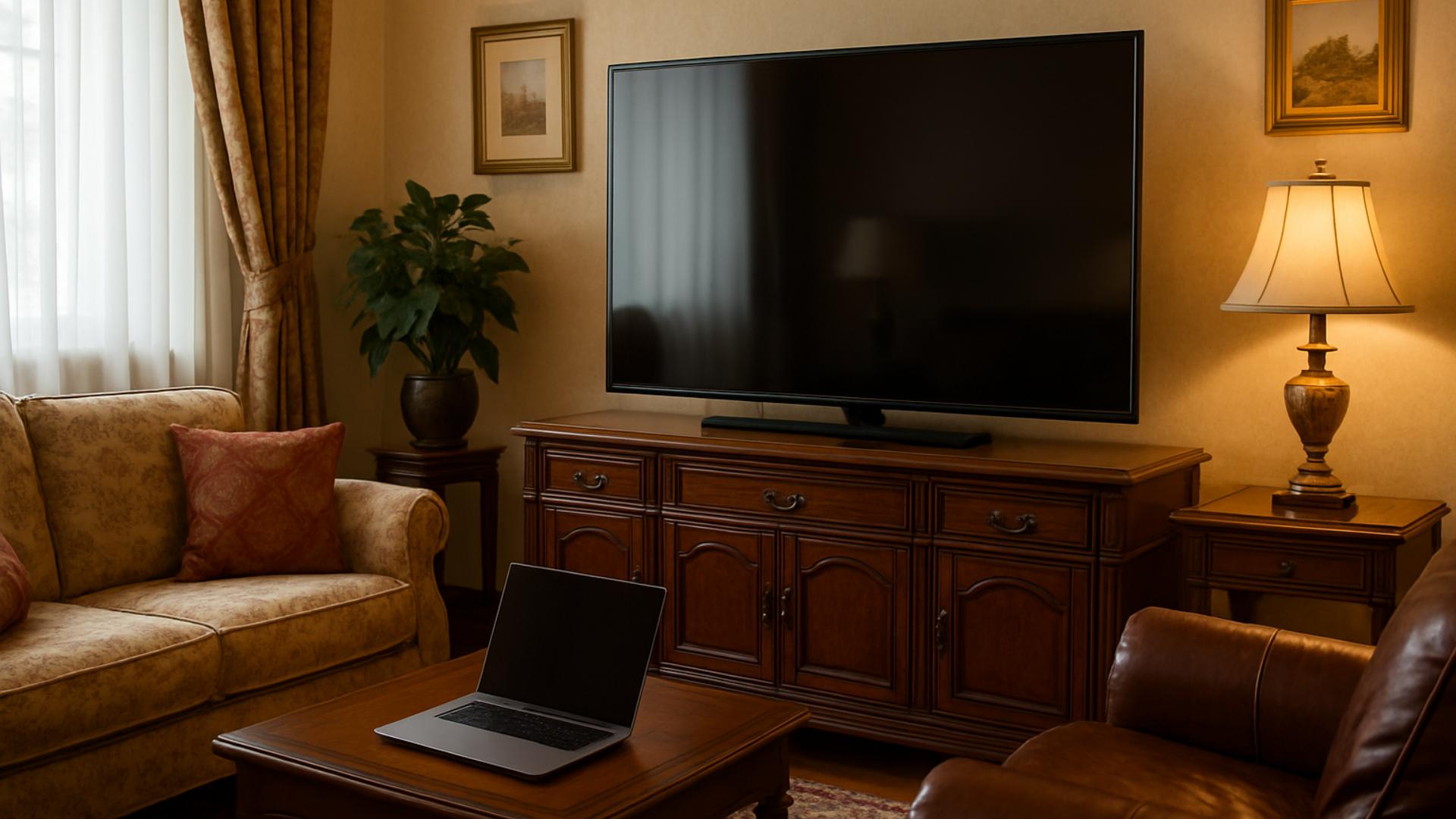
Two moves are worth knowing. A matt or chalky finish on the walls kills the sheen mismatch that makes plastic housings look cheap against old timber, because the room stops offering a glossy reference point. And a dark wall behind a screen largely dissolves the black rectangle problem: a television reads as a void on a pale wall and as a panel on a deep green or charcoal one, which is why the same set can look intrusive in one room and unremarkable in another.
Textiles finish the job. A modern object gains a great deal from being surrounded by materials of a different age: a wool rug, heavy curtains, an old textile on a chair. This is also the cheapest correction available if a room already feels too new.
Lighting, the one technology that unambiguously helps
Old rooms were designed for firelight, candles and later gas, all of which sat low in the colour temperature range and rendered warm materials generously. Modern lighting can reproduce that better than anything available in the twentieth century, provided you buy on numbers rather than on descriptions.
Look for a colour rendering index of 90 or above, which keeps timber, brass and textiles looking like themselves, and a colour temperature at the warm end, usually 2200 K to 2700 K in a period reception room. Dim-to-warm lamps, which drop in colour temperature as they dim rather than simply getting darker, are the closest current equivalent to candlelight.
If the room contains real art or historic textiles, the museum figures are worth borrowing. Conservation guidance drawn from CIE and ICOM-CC practice puts oil paintings at roughly 150 to 200 lux and works on paper, watercolours and textiles at 50 lux or below, with annual cumulative exposure treated as the real limit rather than any single reading. A picture light left on all evening every evening does far more damage than a brief brighter viewing.
| Object | Show or absorb | Reason |
|---|---|---|
| Well-detailed audio equipment | Show | Honest manufacture reads as craft, not clutter |
| Television | Absorb | No screen improves a room when switched off; use a dark ground |
| Switch plates and sockets | Show | Matched metal finishes become part of the ironmongery |
| Routers, hubs, cabling | Absorb | Nothing is gained by seeing them, and heat needs managing anyway |
What the building itself may not allow
Before any of this becomes an installation, check the status of the building. Protected, listed and conservation-area properties are governed by consent regimes that differ by country and often by municipality, and works that seem minor internally, such as chasing cables into original plaster or lime render, can require permission. Wireless equipment is frequently the conservation-friendly answer for exactly that reason, with one caveat: thick masonry and lath and plaster attenuate signal badly, so plan for more than one access point rather than assuming one will cover the floor.
New circuits are a separate question again. Wherever you are, electrical work of that kind falls under a national wiring standard and belongs to a qualified electrician, not to the weekend.
Questions readers send us
How do I add technology to a vintage living room without losing its character? Reduce the number of visible devices before you try to style the ones that remain. One speaker of decent quality, sited well, beats four small ones scattered around the room, and every device removed is one you no longer have to reconcile with the decor.
Is a traditional kitchen the hardest room? It is the most equipment-dense, so integrated appliances behind cabinet fronts genuinely earn their cost there. Leave one deliberate modern element visible, usually the tap or the hob, so the room does not look like it is pretending to have no plumbing.
Can a rustic or farmhouse scheme take smart heating and lighting? Comfortably, because most of it is invisible in use. The parts you see are the switch plates, the thermostat and the sensors, so specify those in a finish that matches the room’s existing metalwork and accept a plain modern shape rather than a mock-antique one. Our guide to blending technological and traditional elements goes through those objects one by one.
Thinking about the energy side as well as the look?
Connected heating, lighting and metering change running costs as much as they change a room.
Sources: Canadian Conservation Institute, guidance on the care of furniture and wooden objects; museum lighting practice derived from CIE 157 and ICOM-CC exposure categories.