
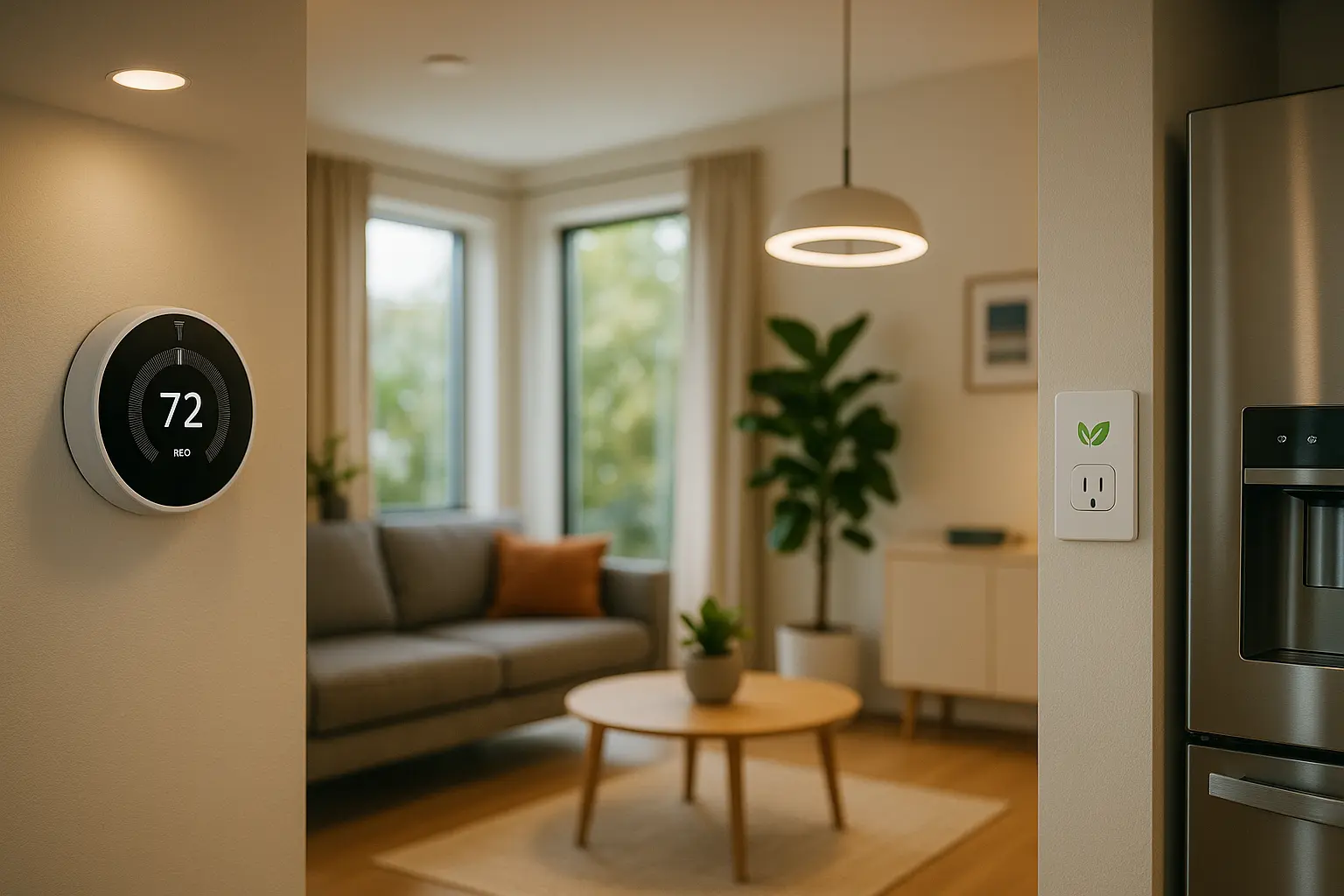
There is an uncomfortable fact behind most smart home energy guides: the devices are very good at managing a heating system, and completely powerless to improve the building around it. Knowing which of the two you are buying is the whole exercise.
The short version
- Heating and cooling control delivers the largest single saving in most homes.
- Lighting savings now come mainly from switching to LED, with automation adding a smaller increment.
- Monitoring changes behaviour, which is where a second tranche of saving tends to appear.
- Interoperability decides whether the system still works after your next appliance purchase.
Put the effort where the energy actually goes
Space heating and cooling dominate household energy use in most climates, which is why thermostat control comes first in any serious sequence of measures. The published evidence is unusually specific here. To carry the ENERGY STAR label, a smart thermostat has to demonstrate a runtime reduction whose lower 95% confidence limit of the weighted national average is at least 8% for heating and 10% for cooling, measured across real installations rather than in a laboratory.
The caveat published alongside those criteria deserves as much attention as the numbers. The EPA explicitly advises against treating national estimates as a deemed saving for any individual home, because heating and cooling degree days, HVAC equipment and building characteristics vary too much between regions. A thermostat in a mild maritime climate with a modern heat pump is not running the same experiment as one in a continental winter with an oversized gas boiler.
Lighting: the saving already happened
Most of the reduction available from lighting was banked the day incandescent lamps were replaced by LED, and no amount of scheduling recovers that saving twice. What smart lighting adds after that point is real but modest: rooms that stop being lit when empty, daylight-linked dimming, and an end to the corridor that burns all evening for nobody.
The stronger argument for smart lighting is qualitative rather than numerical. Tunable output lets a single fitting serve a working afternoon and a quiet evening, which is genuinely useful in rooms with poor daylight. We go into that side of the problem in our guide to lighting a space without natural light, where the constraint is comfort rather than consumption.
Measure before you automate
A whole-home energy monitor is the least decorative purchase on this list and often the most instructive. It reveals the loads nobody suspected: the second fridge in the garage, the pool pump on a legacy schedule, the office equipment that never actually sleeps.
Standby consumption is a good illustration of why measurement beats assumption. Published estimates of what always-on devices cost a household vary considerably between countries and between studies, and quoting a single global percentage would misrepresent that spread. Your own meter settles the question for your own house in a week, which is worth more than any national average.
Interoperability is the durability question
A smart home assembled from four incompatible ecosystems is a smart home that will be partially abandoned within three years. This is where the Matter standard, published by the Connectivity Standards Alliance, has changed the calculation. Matter 1.4, released in November 2024, added device types that matter directly to energy management, including heat pumps, water heaters, solar inverters and batteries, alongside improvements to the energy management and thermostat clusters. Matter 1.5 followed in November 2025 with further energy management capability, cameras and a unified approach to closures such as shades and garage doors.
The practical reading, as of 2026: certified device support is arriving steadily rather than universally, so the standard is a reason to prefer certified products, not yet a guarantee that everything in a catalogue will cooperate. Checking certification before purchase is a five-minute habit that avoids an expensive one.
| Measure | Where the saving comes from | Main limitation |
|---|---|---|
| Smart thermostat | Reduced heating and cooling runtime | Highly climate and equipment dependent |
| Zoned or room controls | Not conditioning empty rooms | Needs compatible emitters |
| Smart lighting | Occupancy and daylight linking | Small once LED is fitted |
| Energy monitoring | Finding unknown loads, behaviour change | Saves nothing unless acted on |
| Load shifting | Cheaper tariff periods | Cuts cost more than consumption |
Shifting load is not the same as saving energy
With a time-of-use tariff, running the dishwasher, the washing machine or an electric vehicle charger overnight lowers the bill without lowering consumption by a single kilowatt-hour. That distinction is worth keeping clear, particularly when a product’s marketing blurs the two. Cost reduction is a legitimate goal, and on a variable tariff it is often the larger of the two effects, but it is a different claim from efficiency.
Retrofit order that we would follow
Start with the envelope if it is poor, because control cannot compensate for heat leaving a building. Then instrument, so that decisions rest on data. Then take heating and cooling control, which is where the measured savings sit. Lighting, appliance scheduling and load shifting come after, each adding a smaller layer. Reversing that order is how households end up with an impressively connected home and an unchanged bill.
Questions readers send us
Will a smart thermostat pay for itself? Often, but the period depends on climate, tariff and how the house was heated before. A household already running a disciplined manual schedule will see less than one that heated an empty house all day.
Do smart devices use meaningful energy themselves? Individually the draw is small, but it is continuous and it accumulates across dozens of devices. It rarely cancels the savings; it does argue against connecting things for the sake of connecting them.
Is a hub still necessary? For several device types, yes, and Matter has not removed that requirement entirely. Check what a given product needs before assuming an app is sufficient.
What about privacy? Energy data is behavioural data: it shows when a home is occupied. Reviewing what a manufacturer stores, and preferring local control where it is offered, is a reasonable part of the specification rather than a fringe concern.
Automation, seen from the house rather than the app
The efficiency gains are easier to judge once you know how an automated home actually behaves day to day.