
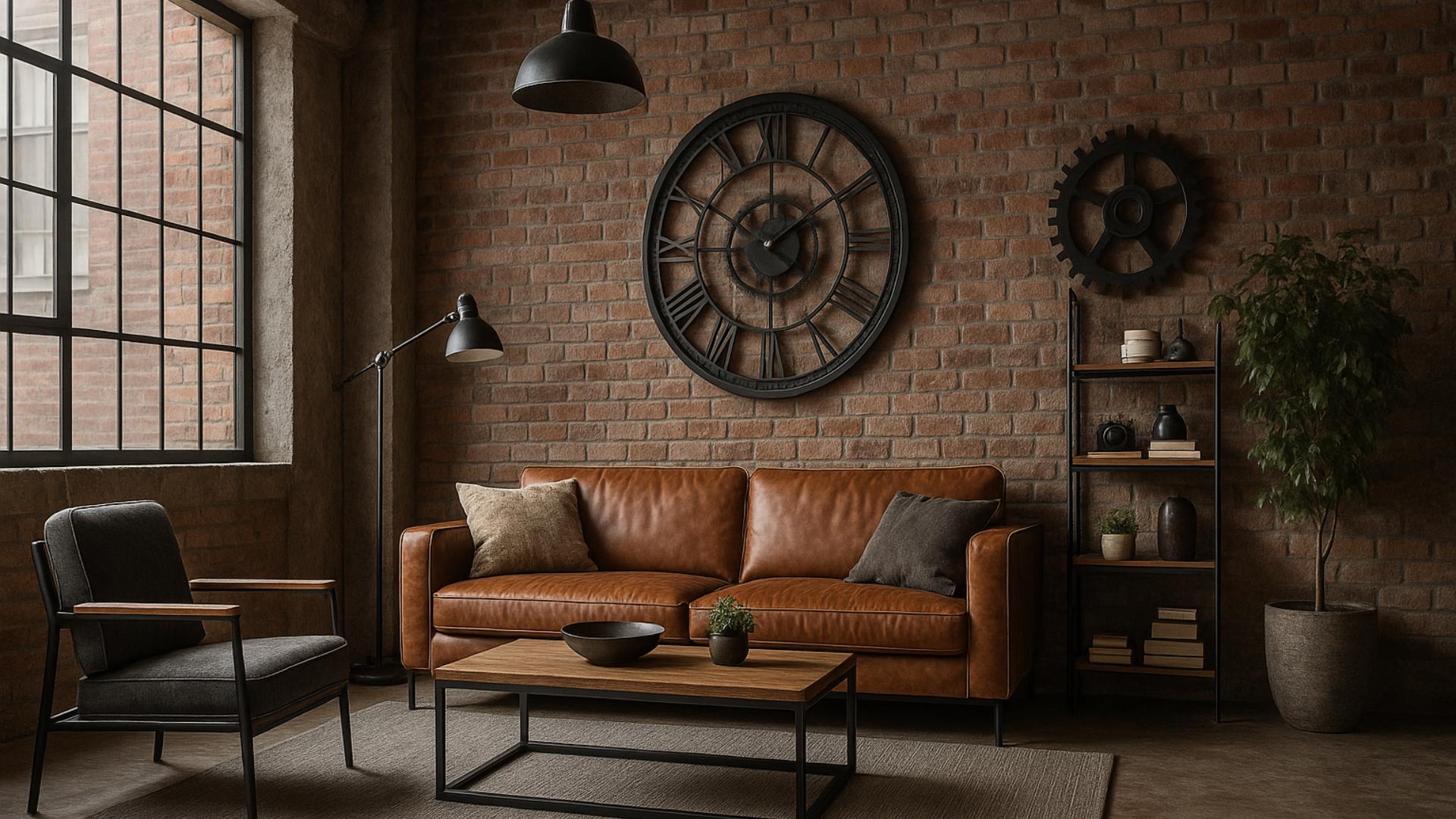
Industrial style is almost always presented as a demolition job. Strip the plaster, expose the joists, knock through. That advice is useless to anyone renting, and expensive for anyone who owns a flat built in the last forty years with nothing interesting hiding behind the walls.
In order of commitment
- Change the lamps before anything else. It is the cheapest move and it alters the room the most.
- Pick one metal and hold to it across the whole space, including door furniture and light switches.
- Bring in one large piece of honest timber rather than several small distressed accessories.
- Leave anything structural, including exposing brick, until you understand what it does to the wall.
Start with light, because it costs least and changes most
Colour temperature does more work here than any object you can buy. The warehouse look is built on light in the 2200 K to 2700 K range, which reads as amber and throws long shadows, rather than the 4000 K neutral white fitted as standard in most rental flats. Swapping the lamps in a room takes ten minutes and costs less than a cushion.
What has changed is where that light comes from. Under EU Regulation 2019/2020, the remaining mains halogen capsules with G4, GY6.35 and G9 bases were phased out on 1 September 2023, and linear T5 and T8 fluorescent tubes in August of the same year, so the glowing glass filament that defines this style is now an LED product rather than a tungsten one. That is good news for running costs and it does mean reading the packet rather than the product name: check the stated colour temperature in kelvins, the lumen output, and whether the lamp is dimmable, because a great many decorative filament LEDs are not. What is still sold as an Edison bulb is now almost always an LED filament copy of one, and the good ones are very convincing at low output while the cheap ones give themselves away by flickering on a dimmer.
Three placements carry most of the effect. A pendant hung low over a table, close enough that you see the source. A clamp or scissor-arm lamp fixed to a shelf edge, which is the one genuinely factory-derived object most homes can accommodate. And a plug-in wall light on a swing arm, which gives renters the look of a hardwired sconce with no electrical work and nothing to make good when the tenancy ends.
One metal, repeated, beats four metals mixed
Choose a single metal family and repeat it deliberately. Blackened or powder-coated steel is the safe default, aged brass the warmer alternative, and the failure mode is always the same: a black pendant, a chrome tap, a brushed nickel handle and a raw steel shelf bracket in one room, which reads as accidental rather than assembled.
Two practical notes that the inspiration photographs never mention. Raw, unlacquered steel will mark and eventually rust in a bathroom or above a hob, so powder coating earns its keep anywhere near steam. And scaffold pipe shelving, the classic entry point into this style, gets heavy far faster than people expect once it is loaded with books or crockery. Fix into the timber studs wherever you can find them. Where you cannot, toggle-type plasterboard anchors are typically rated by their manufacturers at somewhere around 25 to 30 kg each in standard 12.5 mm board, and that figure is per fixing under ideal conditions, so read the rating on the pack and treat a fully loaded shelf run as a job for a stud detector rather than optimism.
Timber, and what to check before you buy it reclaimed
One large piece of honest wood does more than a shelf of small distressed objects. A thick tabletop, a run of scaffold boards, a single reclaimed door repurposed as a desk. The grain, the saw marks and the slight unevenness are the point, which is why a factory-distressed lookalike rarely convinces.
Buying genuinely reclaimed timber comes with two checks worth making before it enters the house. Old boards frequently carry embedded nails, screws and grit that will destroy planer blades and are a real hazard to handle, so inspect and denail before any machining. More seriously, old paint on salvaged timber may be lead based: domestic lead paint was restricted in the United States in 1978 and in the United Kingdom in February 1992, with other countries following their own timetables. Anything painted before those dates should never be dry-sanded or burned off. Have it tested, or leave the paint intact and design around it.
The reversible versions of brick and concrete
Exposing masonry is the intervention people reach for first and regret most often. Beyond the fact that many buildings have nothing worth exposing under the plaster, an internal finish is doing a job: it contributes to the thermal behaviour of an external wall and to how the room sounds. We looked at that in detail in our guide to integrating a warm industrial style into your interior, and the short version is that a stripped wall is colder and louder than the one you started with.
The substitutes have improved enormously. Brick slips are thin facing tiles that give the texture of exposed brick on any sound wall and come off again. Microcement gives a seamless concrete surface at a few millimetres thickness, which matters because a real concrete worktop is a structural load most kitchen units are not designed to carry. Concrete-effect porcelain is now convincing at floor scale and, unlike poured concrete, does not need sealing every couple of years.
| Element | Worth the real thing | Fine as a substitute |
|---|---|---|
| Timber surfaces | Yes, you touch them daily and the grain shows | Rarely convincing in laminate |
| Brick walls | Only where masonry is already exposed and dry | Brick slips, reversible and thermally neutral |
| Concrete | Only where the structure was designed for it | Microcement or concrete-effect porcelain |
| Metalwork | Yes, thin imitations read as thin immediately | Powder-coated steel instead of raw, near water |
Three ways it tips into looking like a themed bar
The first is uniform distress. When every object has the same degree of wear, the effect stops looking accumulated and starts looking bought in one delivery. Keep at least one genuinely new, sharp-edged element in the room.
The second is an all-grey palette. Concrete, steel and slate together, with nothing warm, produce a room that photographs beautifully and is unpleasant to sit in for an evening. Leather, wool, unbleached linen and one plant do more for this style than another metal object.
The third is scale confusion. Factory objects were built oversized because factories are oversized. A pendant that looks enormous in a shop is often correct over a dining table and absurd in a hallway, so measure the drop and the diameter against the space rather than against the photograph.
Two questions that come up early
Can this work in a rented flat with white walls and no features? Yes, and it is the situation the approach above was written for. Lamps, one metal family, one large timber piece, freestanding shelving and textiles will carry it. Peel-off brick slip panels and removable adhesive fixings cover most of the rest.
Does everything have to be salvaged? No. Mixing one or two pieces with real history among otherwise new furniture is more convincing than a room furnished entirely from reclamation yards, which tends to read as a set rather than a home.
Does it work in a small or dark room? It works in a small room, less easily in a dark one. The style depends on shadow and contrast, which need something to contrast against, so in a room with little daylight you have to add light sources rather than dim the existing ones. Three or four low-output points around the room will hold the atmosphere far better than one bright ceiling fitting turned down, and pale walls stop the whole thing from closing in.
Want the full set of rules before you start buying?
The complete guide covers proportion, palette and the pieces that carry the style across a whole flat.
Sources: Commission Regulation (EU) 2019/2020 on ecodesign requirements for light sources, phase-out dates of 2023; US Consumer Product Safety Commission lead paint rule of 1978; UK restriction on lead carbonate and lead sulphate paints, February 1992.