Most advice about large walls treats the wall as the subject. It is not. The subject is the position someone occupies when they look at it, and the distance between the two. Change that distance and the same arrangement goes from generous to cluttered without a single object moving.
The order of decisions
- Identify the seat, the doorway or the stair from which the wall is actually read.
- Set the empty margin as a quantity, before choosing a single object.
- Establish the substrate and the fixings, because that rules some options out entirely.
- Light the wall for what is on it, or the texture you paid for will not be visible.
Start from where the wall is seen, not from the wall
A wall is almost never viewed from the middle of the room at a polite four metres. It is viewed from the sofa, from a doorway at an oblique angle, or in passing along a corridor at arm’s length. Each of those produces different rules, and mixing them is why so many large walls feel unresolved.
At close range, in a hallway or a stairwell, the eye reads detail and cannot take in the whole surface at once. Small work, dense hangs and fine texture reward that. From five or six metres, in an open living space, the opposite holds: detail dissolves and only silhouette and value survive the distance. A dozen small frames on a distant wall read as a grey rectangle of noise, which is the most common form of overdoing it, and no amount of rearranging fixes it.
The test costs nothing. Sit where you actually sit, then look. If the objects on the wall are not legible from there, they are decoration for a viewpoint nobody uses.
| Seen from | Typical distance | What holds up | What collapses |
|---|---|---|---|
| Corridor, stair | Under 1.5 m, oblique | Dense hangs, small work, fine texture | One oversized piece, seen edge on |
| Seated, same room | 2 to 3 m | Medium pieces, shallow shelving, relief | Anything requiring a step back |
| Across an open plan | 4 m and beyond | One large gesture, strong value contrast | Multiple small frames, subtle tonal work |
Decide the emptiness first, as a quantity
Restraint is easier to hold when it is a measurement rather than an intention. Before choosing anything, decide what proportion of the wall stays bare and mark it. A useful discipline on a genuinely large surface is to keep everything inside a defined field and leave the outer margins untouched, including the corners, which is where accumulation always begins.
Walls become overloaded slowly and by addition. Nobody plans a crowded wall; they add a good piece to a finished one, twice a year, for five years. Writing down the intended empty area at the start gives you something to check new arrivals against, and it makes the answer no easier to reach.
What is behind the plaster decides what is possible
The substrate is not a detail to sort out on installation day. A solid masonry or concrete wall accepts weight almost anywhere. A stud partition accepts it only where the framing is, and the timber or steel studs generally sit at regular centres, sixteen or twenty-four inches in imperial framing, four hundred or six hundred millimetres in metric. Between them there is only board.
Two rules keep this safe. Each fixing should be rated for the full load rather than a share of it, because loads rarely distribute the way a drawing suggests. And anything heavy, a large mirror in particular, belongs on the framing or on a timber batten screwed across two studs and then hung from that. The batten is the professional answer and it takes ten minutes.
Weight above a bed, a sofa or a cot deserves a separate thought rather than a general one. If there is any doubt about the fixing, the piece goes somewhere else or on the floor, leaning. Rented flats and walls that cannot be drilled push you towards leaning, picture rails and full-height panels that sit on the floor, and those are legitimate solutions rather than compromises.
Light is half the styling, and it is usually missing
A textured wall finish, a plaster relief or a timber panel is only visible when light crosses it at an angle. Under a flat, front-on wash it disappears, and the money spent on the finish disappears with it. Grazing light, placed close to the wall and aimed nearly parallel to it, is what makes texture read.
The reverse applies to flat artwork, which wants an even wash rather than a raking beam, and a single downlight dropped near the wall will produce a scallop of light and two dark thirds. Where a wall is the main event in a room, the lighting for it should be specified alongside it rather than inherited from the ceiling layout. Our guide to lighting an interior without natural light covers the same mechanics for rooms where daylight is not available at all.
The three ways large walls go wrong
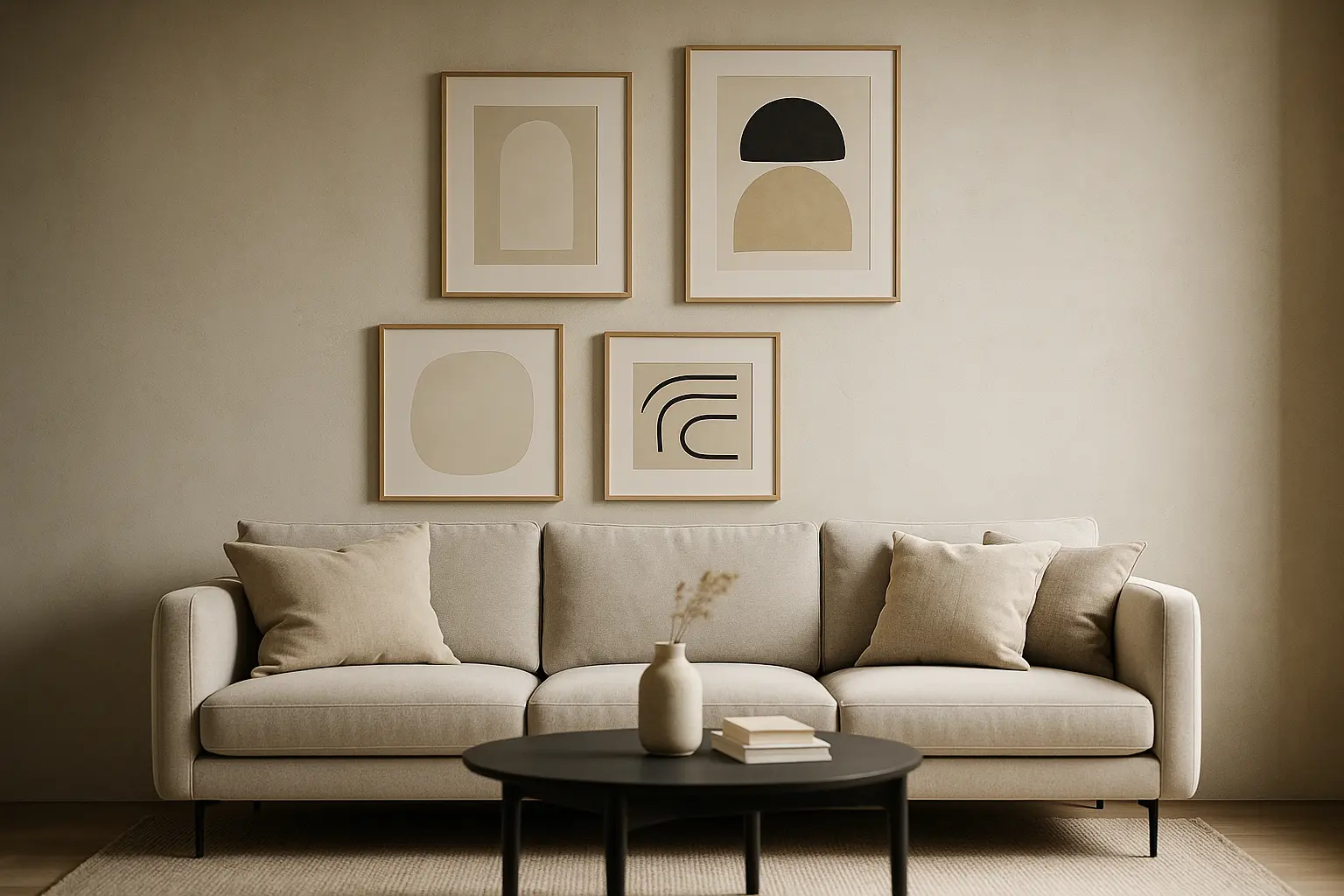
The first is accumulation, described above, and it accounts for most cases. The second is misapplied symmetry: a perfectly symmetrical arrangement on a wall that is itself asymmetric, with a door at one end or a radiator off centre, draws attention to the irregularity instead of absorbing it. On an irregular wall, an off-centre composition anchored to the furniture usually reads calmer than a centred one.
The third is matching. Choosing every object on a wall to relate to the sofa produces a wall with no independent life, and it dates precisely when the sofa does. Let the wall answer to the architecture, the window position and the ceiling height, and let the furniture be a separate conversation.
Questions that come up before the drill goes in
How large should a single piece be on a very wide wall?
Large enough that it does not need a companion. On a wall over three metres wide this usually means thinking in metres rather than in catalogue frame sizes, and a piece that feels slightly too big in the shop is generally right on the wall.
Does a large wall have to be decorated at all?
No. A well-finished empty wall is a legitimate design decision, particularly in a room that is already busy with windows, joinery or a strong floor. Emptiness only reads as unfinished when the surface itself is poor.
What about a wall that has to carry a television?
Treat the screen as the dominant object and stop competing with it. Everything else on that wall should be quieter than the black rectangle, because for several hours a day it will be the brightest thing in the room.
Can shelving solve a large wall?
It can, provided it is treated as line rather than storage. Long, shallow, deliberately underfilled shelves draw a horizontal across the wall. The same shelves filled to capacity turn the wall into a cupboard without doors.
Looking for the composition itself?
Once the viewpoint, the margins and the fixings are settled, there are a handful of arrangements that reliably hold a big surface on their own.
Published on 16 May 2025. Updated on 15 August 2026. Sources: standard residential framing centres of 16 and 24 inches, or 400 and 600 mm; manufacturer load ratings for hollow-wall and plasterboard fixings, which are stated per fixing and vary by product; general lighting practice on grazing light and wall washing.