
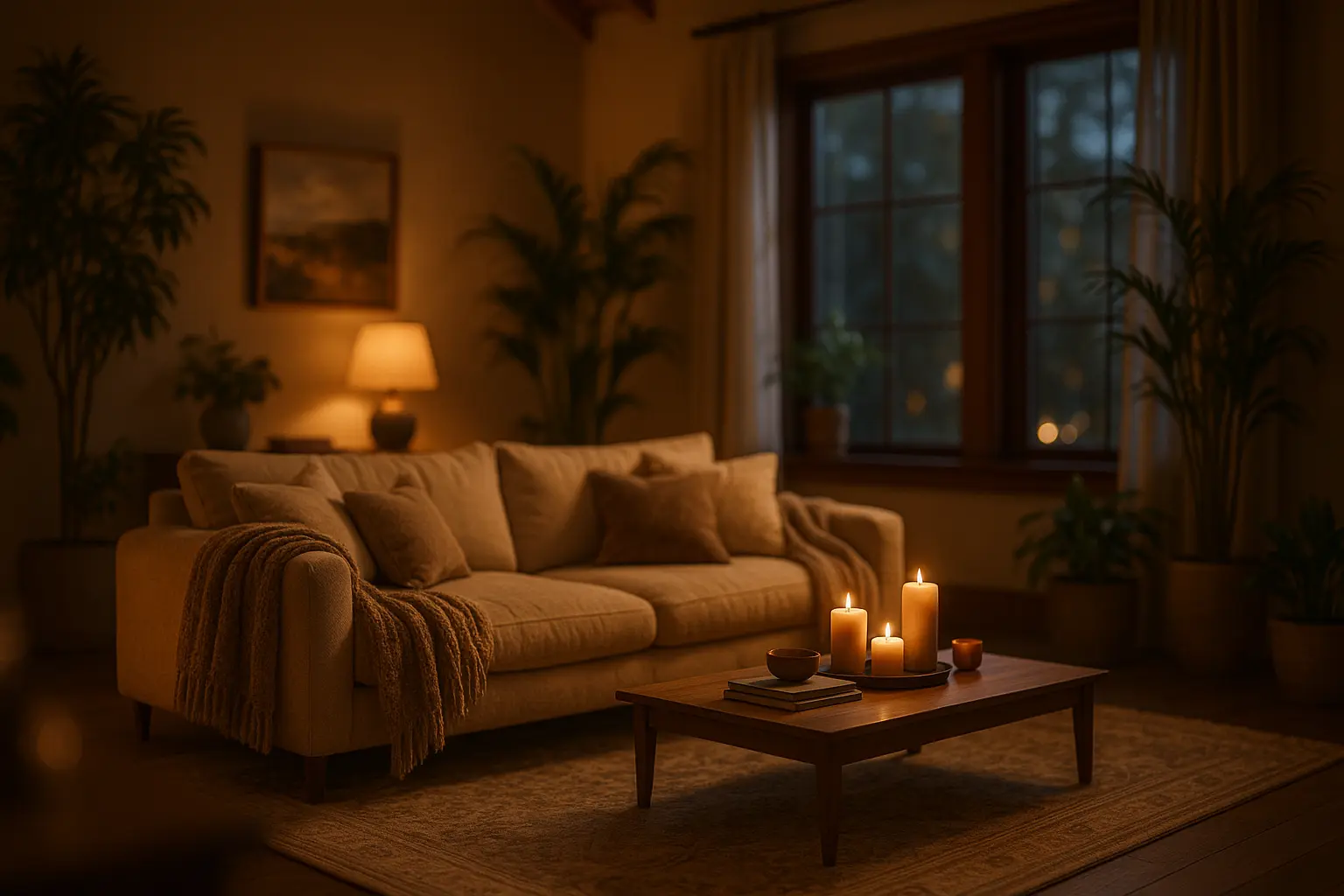
A tall room that feels unwelcoming is usually described as needing warmth, and treated with textiles. That is one third of the answer. The discomfort in a high-ceilinged room is acoustic, thermal and luminous before it is decorative, and each of those has a physical cause you can act on.
Why the room feels the way it does
- More volume with the same soft surfaces means a longer reverberation time, and hard rooms feel unfriendly.
- Warm air rises and pools above the ceiling line, so the heat you are paying for sits where nobody is.
- A light source twice as far away delivers a quarter of the illuminance, which is why tall rooms read as gloomy.
- Standard furniture proportions look stranded, because they were designed for a ceiling around 2.4 metres.
What is actually happening in a tall room
Reverberation time depends on volume. The Sabine equation, which has underpinned room acoustics since 1898, expresses the reverberation time as 0.161 times the volume of the room divided by its total absorption. Raise the ceiling and the volume goes up while the absorbent surfaces, the rug, the sofa, the curtains, stay exactly as they were. The result is a longer tail on every sound, less intelligible speech across the room, and the hard, echoing quality people describe as feeling like a lobby.
The thermal half is simpler. Warm air is less dense and rises, so in a tall room it collects above the occupied zone and stays there. Heating a volume in order to keep the top two metres of it comfortable is an expensive way to be cold at sofa height.
The lighting half is pure geometry. Illuminance falls with the square of the distance from the source, so a fixture on a four-metre ceiling delivers roughly a quarter of the light at floor level that the same fixture would deliver from two metres. Tall rooms are not badly lit because the fittings are weak. They are badly lit because the light is too far away.
1. Bring the light down to where people are
The single most effective change is to stop lighting a high room from its ceiling. Pendants, table lamps, floor lamps and wall lights create a luminous ceiling at two metres, well below the real one, and that lower plane is what the eye reads as the top of the room in the evening.
Over a dining table, the lighting trade works to a hang of roughly thirty to thirty-six inches, about seventy-five to ninety centimetres, above the tabletop, with an allowance of a further three inches for each foot of ceiling above eight feet. That allowance is worth knowing precisely because it is often misread as a licence to hang the fitting far higher. It is a small correction, not a proportional one. Three or four pools of light at low level will always beat one powerful source overhead.
2. Treat the room acoustically before you treat it decoratively
Absorption is the lever the Sabine equation gives you, and in a domestic room it comes from soft, deep, porous things. A large rug with a dense underlay, full-length curtains in a heavy weight, upholstered rather than hard-shell seating, and a filled bookcase all add absorption. Bare plaster, glass and a polished floor all remove it.
Scale the response to the volume rather than to the floor area, since the volume is what changed. A room with a five-metre ceiling needs materially more soft surface than the same footprint at 2.4 metres, which is why a tall living space furnished exactly like a normal one still sounds wrong. Acoustic felt panels, increasingly available as decorative wall finishes, do the same job where the aesthetic allows it.
3. Give the room a second horizon
Tall rooms lack a datum. Adding a strong horizontal line somewhere between two and 2.4 metres gives the eye a place to stop, and the space above it then reads as generous rather than uncontained. A picture rail, a panelled dado run high, a colour break, tall joinery that deliberately stops at door head height: all of these do the same work.
The door head is the natural line to borrow, since in most homes it sits a little over two metres and every opening in the room already agrees with it. Extending that height across the walls in some material or tonal form costs little and does more for the proportions of a tall room than any amount of furniture. It is also the reason a warm industrial scheme works so well in converted volumes, since exposed rails, tracks and steelwork tend to establish exactly this kind of horizontal.
4. Mix the air instead of adding heat
Stratification is fixable with movement rather than with more energy. The US Department of Energy’s winter advice for ceiling fans is to reverse the direction so the blades turn clockwise, and to run them at low speed: the gentle updraft pushes the warm air that has collected at ceiling level back down the walls without creating a draught.
Two related points help. Heat emitters low on the wall, or underfloor, put warmth where it is used, whereas a high-level source in a tall room feeds the stratified layer directly. And warm rooms with cold surfaces still feel cold, because the body loses heat by radiation to those surfaces; insulated shutters or lined curtains on a large window will do more for perceived comfort than a higher thermostat setting.
5. Choose fewer, larger things
Standard furniture is proportioned for a standard ceiling, so in a tall room it looks stranded, and the instinct is to add more of it. That instinct is wrong. Scale is what answers height: one large artwork rather than nine small ones, a tall bookcase or a full-height cabinet rather than a low sideboard, a generous pendant rather than a modest one.
The ceiling itself is also fair game. Taking the wall colour up onto the ceiling, or painting it a deeper tone than the walls, visually lowers it and closes the room down. On a very tall ceiling this is one of the few interventions that changes the perceived proportions rather than merely decorating them.
Straight answers to the usual questions
Should curtains be hung at the ceiling in a high room?
Not automatically. Hanging a rod at ceiling level is standard advice for making a normal room feel taller, which is the opposite of what a five-metre room needs. Aligning the rod with the second horizon described above, rather than with the ceiling, keeps the window in proportion with the rest.
Does a dark ceiling make a tall room feel oppressive?
Rarely, in a genuinely tall room. The height that makes a dark ceiling risky in a standard interior is exactly what makes it comfortable here, provided the lighting has already been brought down to occupied level.
Is a mezzanine or a suspended element worth considering?
It is the most thorough answer, and the most involved. Anything structural, or anything affecting escape routes and fire compartmentation, belongs with an architect or engineer and the relevant local approvals rather than with a weekend project.
Lighting is doing most of the work here
The techniques for building a comfortable low-level scheme are the same ones used in rooms with no daylight at all.
Published on 16 May 2025. Updated on 15 August 2026. Sources: Sabine reverberation equation, RT60 = 0.161V/A, standard in architectural acoustics; US Department of Energy guidance on reversing ceiling fan direction in winter; published lighting-trade guidance on pendant mounting heights above dining tables and the allowance for ceilings above eight feet.