Wood and metal are the easiest pairing in interior design to get right on a mood board and the easiest to get wrong in a workshop. Nothing in the combination fails for aesthetic reasons. It fails where the two materials physically touch.
What decides whether the pairing survives
- Fastener metallurgy, because plain steel in oak produces black staining.
- A fixing method that lets a solid top expand and contract across its width.
- One metal family per wet zone, to avoid galvanic corrosion.
- A deliberate hierarchy of finishes, warm against cool, rather than an accumulation.
The mood board stops where the two materials meet
Photographs of wood-and-metal interiors are taken on the day of installation. What separates a pairing that still looks intentional after five years from one that looks tired is almost never the shade of the timber or the finish of the metal. It is the screw, the bracket and the bolt hole, and none of those appear in the picture.
This is worth stating plainly because the usual advice on this subject stops at colour temperature. Warm wood, cool metal, balance the two. That advice is not wrong, it is simply downstream of the decisions that determine whether the piece survives its first winter.
Oak and iron make ink, and the reaction is permanent
Tannin-rich species react with iron to produce a deep blue-black stain. Oak is the notorious case, and chestnut, walnut and western red cedar behave similarly. The reaction needs only moisture to start, which is why the marks often appear the morning after a spell of damp weather rather than on the day the screw went in. The US Forest Products Laboratory has documented the mechanism and the fix for years: the discolouration comes from tannins meeting even trace quantities of iron.
The fix is fastener metallurgy. Stainless steel or brass fixings avoid the reaction, and for anything exposed to damp the marine-grade A4 stainless specification is more resistant to tannic acid than the common A2 grade. There is a detail that catches people out even so: a stainless screw contaminated with iron dust, from a carbon-steel drill bit or from a workshop bench, can still trigger a stain. Zinc-plated and galvanised fixings are the ones to avoid outright in tannin-rich timber, since the coatings vary in composition and staining is a common outcome.
Timber keeps moving after delivery. Metal does not
Wood exchanges moisture with the air around it and changes dimension across the grain as it does. Along the grain the movement is negligible. Across the width of a board it is not, and cabinetmaking practice budgets for roughly three sixteenths of an inch of seasonal movement per foot of board width, which is around five millimetres for every three hundred millimetres. A nine-hundred-millimetre solid top is therefore expected to grow and shrink by a visible amount over the year.
A welded steel base bolted rigidly through that top has no way to absorb the difference. Something has to give, and it is always the timber: the boards cup, the glue lines open, or the top splits along its length. The workshop answers are old and cheap. Figure-eight fasteners pivot as the top moves. Slotted holes or elongated screw holes in the frame let a bolt travel. Z-clips seat in a groove and slide. Any of them costs a few euros and removes the failure mode entirely.
The same principle scales up. Timber shelving inside a steel frame needs a clearance gap at the ends rather than a tight fit. Wide boards fixed hard against a metal upright at both ends are the residential version of a structure with no expansion joint.
In a wet room, keep to one metal family
Two dissimilar metals in electrical contact, with moisture present to act as an electrolyte, set up a galvanic cell in which the less noble metal corrodes faster than it would alone. In a dry living room this is an academic point. In a bathroom, a utility room or around a sink it becomes a maintenance problem, and it shows up first as pitting or a chalky bloom at the junction.
The practical rule is to keep a single metal family wherever water sits regularly, or to isolate the junction with a non-conductive washer or gasket where mixing is unavoidable. Mixing finishes freely, which is the enjoyable part of this pairing, belongs in the dry rooms.
Finish hierarchy: give each metal a job
Once the physical questions are settled, the aesthetic one becomes manageable. The reliable approach is not to limit yourself to one metal, which tends to look flat, but to give each finish a defined role in the room. Fixed ironmongery in one finish, lighting and free-standing objects in another, and no third family without a reason.
Undertone is what makes two metals sit together or fight. Brass and copper read warm and flatter mid to dark timber. Nickel, chrome and stainless read cool and sharpen pale, grey-washed woods. Blackened and mill-finish steel is close to neutral, which is why it is the safest partner when the timber is doing all the work.
| Finish | Reads | Behaves | Best with |
|---|---|---|---|
| Unlacquered brass | Warm, golden | Patinates continuously, can be polished back | Mid and dark timbers, oiled finishes |
| Lacquered brass | Warm, uniform | Stays bright until the lacquer wears unevenly | Low-touch positions, decorative lighting |
| Blackened or mill steel | Neutral, graphic | Needs a wax or lacquer system to stay stable | Anything, including strongly figured wood |
| Stainless and chrome | Cool, clinical | Stable, shows fingerprints on polished grades | Pale, grey or limed timbers |
Where the pairing genuinely earns its keep
In a kitchen, the combination usually works best as timber for the large surfaces and metal for the details you touch, because handles and rails are the cheapest elements to change when taste moves on. Reversing that, with metal cabinetry and timber trim, is a far more expensive commitment to a look.
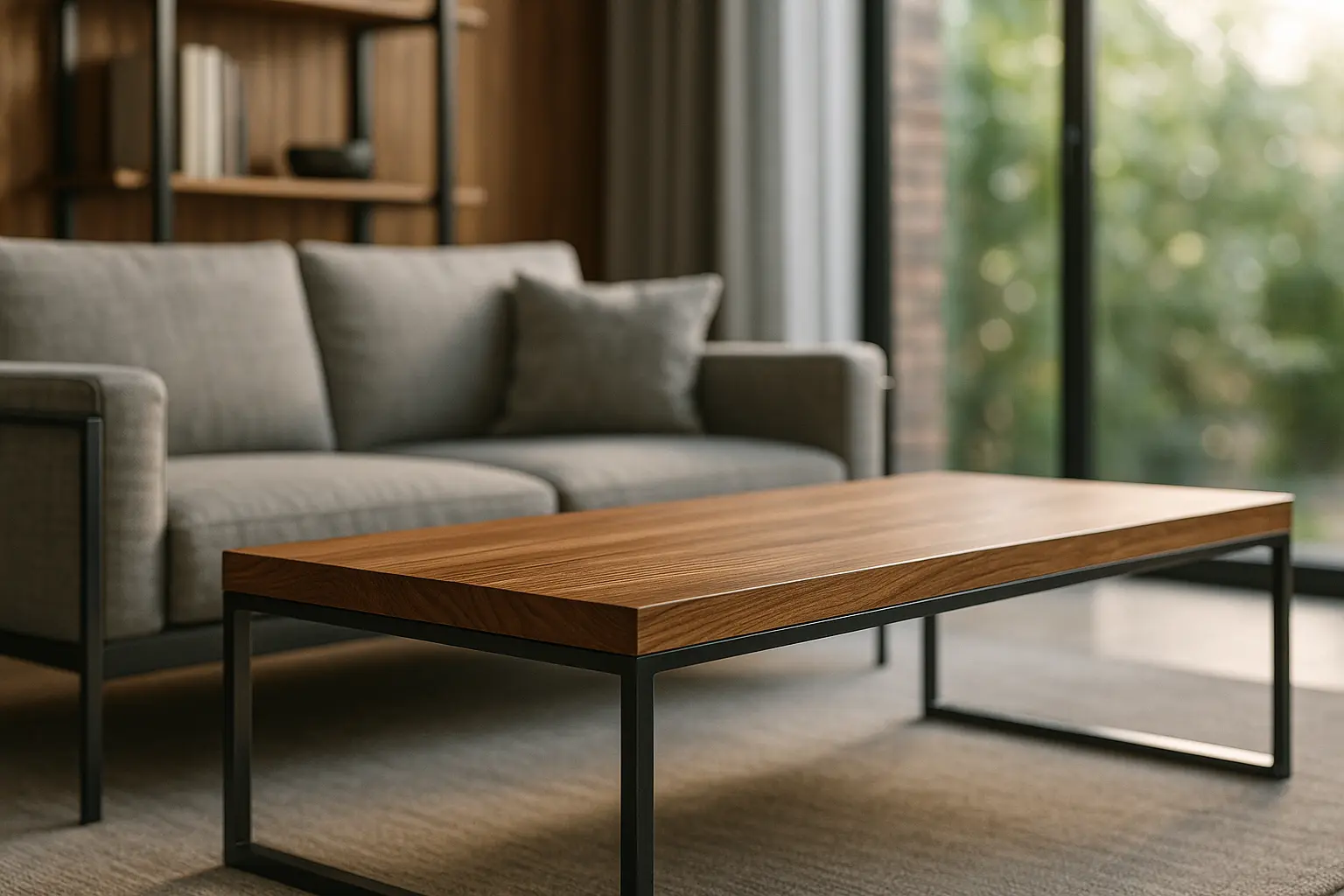
In a living room, a single piece that carries both materials, a table with a timber top on a slender steel frame, does more for a scheme than a dozen small metal objects distributed around it. And in a bedroom, where the pairing can easily turn cold, the metal is best kept off the surfaces that get touched at night. Cool alloys feel exactly as cool as they look at seven in the morning.
The wider material logic behind all of this, including how steel and timber age beside concrete, is set out in our guide to decorating with wood, steel and concrete.
The questions we get asked most
Can I use ordinary steel screws in oak if they will not be seen?
Not reliably. The stain forms in the timber around the fixing and can bleed to the visible face, particularly on thinner sections and near end grain. Stainless or brass costs a few cents more per fixing and removes the risk.
How many metal finishes can one room take?
Two is comfortable, three works when the third is confined to a single object or a single function. Beyond that the room reads as an accumulation rather than a scheme, because nothing is left to act as the constant.
Does the wood have to match the metal in tone?
No, and matching them tends to flatten the effect. The pairing exists because the two materials contrast in temperature and in surface behaviour, so the interesting work is in choosing which of them leads.
What maintenance does each side actually need?
Oiled timber wants a refresh on a schedule rather than a rescue after it looks dry. Waxed or blackened steel needs its coating maintained or it will spot at handled edges. Lacquered and stainless finishes need only cleaning, which is why they suit positions nobody wants to think about.
Is reclaimed timber a problem next to metal?
It introduces one extra check. Salvaged boards frequently contain broken nails and old fixings, and those are both a hazard to tooling and a ready-made source of iron staining. Scan the stock before it goes anywhere near a saw.
The wider principle behind the pairing
Warm against cool, matt against polished, heavy against light. Wood and metal is one case of a broader mechanic worth understanding.
Published on 16 May 2025. Updated on 15 August 2026. Sources: US Forest Products Laboratory, published guidance on iron stain in wood and fastener selection; A2 and A4 stainless specifications as applied to timber framing; Fine Woodworking, published allowances for seasonal cross-grain movement in solid tops.