
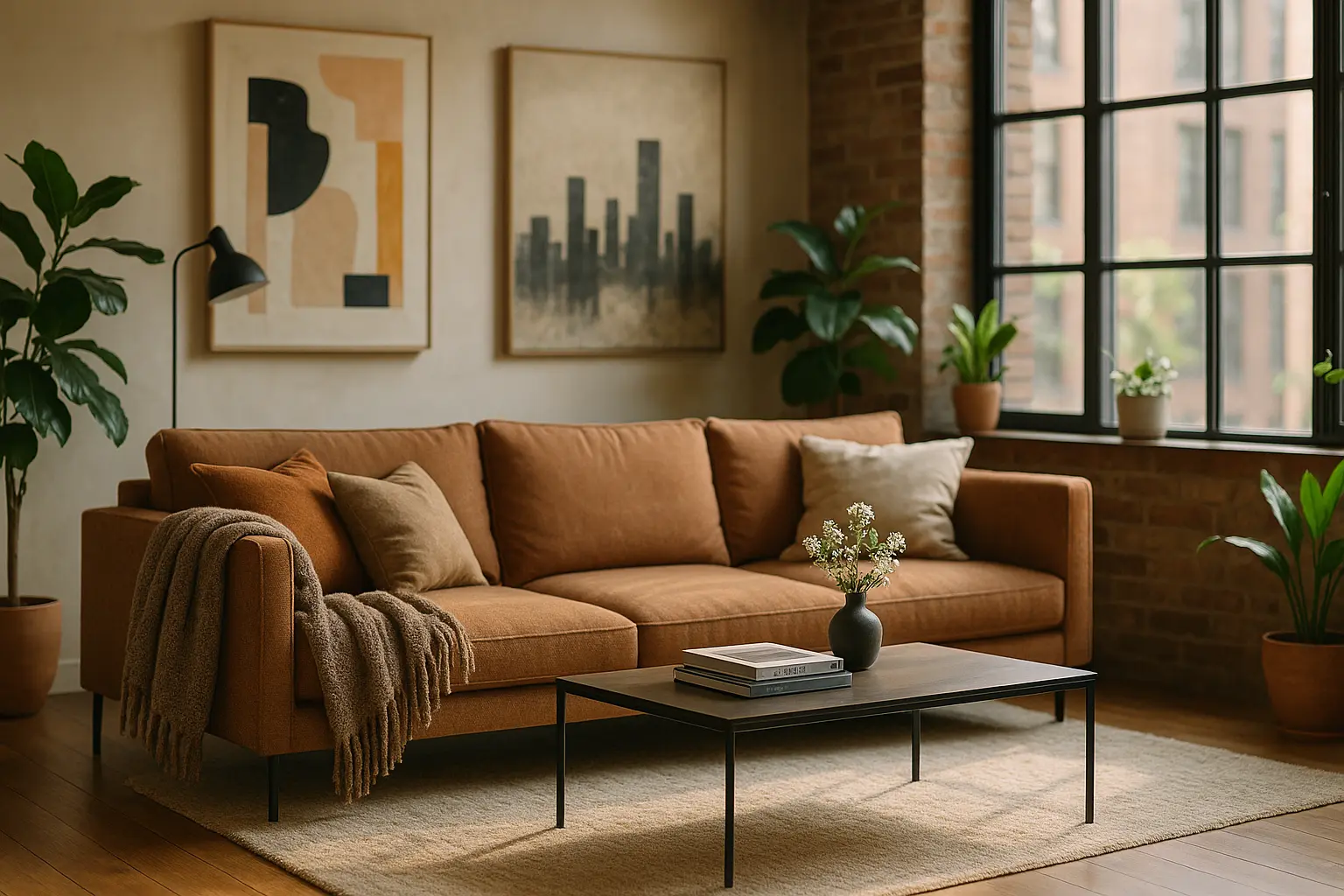
The standard advice for warming up a hard city flat is to buy softer things. More throws, a deeper rug, warmer lamps. It works, up to a point, and then it stops working, because in most urban apartments the thing making the room feel unwelcoming is not the concrete or the steel. It is the street coming in through the window.
En bref
- Curtains absorb sound inside the room; they do not block it coming in. Those are two different physical jobs.
- What you feel as warmth tracks surface temperatures as much as air temperature, which is why a thermostat can read 21 °C in a room that feels cold.
- Blackout is a fitting problem, not a fabric problem. Most light arrives around the curtain, not through it.
- Once the envelope is handled, the textiles, timber and warm lighting do exactly what the mood boards promise.
What the soft layer is being asked to fix
An urban interior is usually defined by what it has: exposed structure, hard floors, large glazing, an open plan. What it lacks is less visible. City flats tend to be acoustically live, thermally uneven, and lit from outside long after dark.
The cozy half of the equation is then asked to solve all of that with fabric. Sometimes it can. A room that echoes will genuinely improve with a heavy rug and full-length curtains, because that is a reverberation problem and textiles are absorbers. A room that hears every bus is a different problem, and no amount of soft furnishing will touch it.
Separating those two failures is the whole trick, and it is where most urban-cozy schemes quietly go wrong.
Noise: absorbing and blocking are not the same job
Sound insulation means stopping sound from getting through a barrier, and it is achieved with mass, multiple separated layers, and airtightness. Sound absorption means reducing how long sound bounces around once it is already in the room, and it is achieved with soft, open-structured materials. Curtains, rugs and upholstery do the second. They do very little of the first.
This is why “soundproof curtains” disappoint against traffic. Textiles are reasonably effective on higher frequencies and weak on the low-frequency energy that dominates road and rail noise, and in any case they are hung over the weakest element in the whole façade. In most flats, the window and its perimeter gaps let in far more sound than the wall around it.
The retrofit that does work follows the mass-spring-mass principle: two panes of glass separated by a generous air gap, with the air acting as the spring. Acoustic retrofit specialists work with secondary glazing gaps of roughly 100 mm for this reason, which is several times the 16 to 20 mm cavity of a standard sealed double-glazed unit. A wider gap performs better at low frequencies, and secondary glazing has the advantage of leaving the original window in place, which matters in a period or protected building.
Sealing matters as much as glass. Sound follows air, so an unsealed sash, a gappy trickle vent or a badly fitted frame will undo good glazing. If a full retrofit is out of reach, sealing the leaks is the cheapest meaningful step, and the curtains then earn their place by taking the edge off the reverberation of what still gets through.
Warmth you feel is not the number on the thermostat
Thermal comfort standards do not work from air temperature alone. ANSI/ASHRAE Standard 55 sets its comfort ranges using operative temperature, which at low air speeds is effectively the average of the air temperature and the mean radiant temperature, the weighted average of the surfaces around you. A room with 21 °C air and a large cold window is not the same room as one with 21 °C air and warm surfaces, and the body notices the difference immediately.
That explains two familiar complaints in urban flats. A polished concrete or tiled floor feels cold at a perfectly normal air temperature because it conducts heat away from bare feet quickly and sits below the air temperature. And a seat placed next to floor-to-ceiling glazing feels draughty even when there is no draught, because the body is radiating heat towards a cold pane.
The remedies are physical rather than decorative. A dense rug with an underlay is a thermal break between foot and slab, which is a genuine comfort intervention rather than a styling one. Moving the seating away from the glass, or improving the glazing, raises mean radiant temperature where people actually sit. Both matter more than the tog of the throw draped over the sofa.
Sorting the complaint from the cause
| The complaint | The actual cause | What changes it | What only feels like it will |
|---|---|---|---|
| “I can hear the street” | Weak glazing, unsealed perimeter | Secondary glazing, sealing gaps | Heavy curtains |
| “The room echoes” | Too few absorbent surfaces | Rug with underlay, full-length curtains, upholstery | Better glazing |
| “It feels cold at 21 °C” | Low mean radiant temperature | Rug over the slab, seating away from glass | Turning the heating up |
| “It never gets properly dark” | Light leaking around the curtain | Overlap, return to wall, pelmet or recessed blind | A thicker fabric |
Darkness is a fitting detail, not a fabric choice
Streetlights, illuminated signage and headlights sweeping a ceiling are part of what makes a city bedroom feel exposed rather than sheltered. The instinct is to buy a heavier fabric, but blackout lining is rarely the failure point. The light comes in around the edges: the gap at the top of the pole, the sides where the curtain stops short of the reveal, the strip below the hem.
Closing those gaps is a joinery exercise. Give the track a generous overlap beyond the reveal, return the curtain to the wall at each end, add a pelmet or a recessed track to close the top, and let the hem sit on the floor rather than above it. Done properly, an ordinary lined curtain outperforms an expensive blackout one hung badly.
Then, and only then, the soft layer
None of this argues against the classic urban-cozy palette. It argues for sequencing it. Work through the fabric of the room first, then spend the budget on the things that are genuinely about pleasure rather than performance.
- Seal and glaze. Deal with air leaks, then the window itself if the budget and the tenancy allow.
- Break the cold floor. A dense rug with a proper underlay, sized so that the seating sits fully on it.
- Fix the curtain fitting. Overlap, return, pelmet, full drop.
- Add absorption where the room is live. Upholstery, a second textile layer, books on open shelves.
- Warm the light. Several low sources at seated height rather than one bright ceiling fitting.
- Then the styling. Timber, ceramics, wool, and the industrial pieces you liked in the first place.
The room that results still reads as urban. The brick stays, the steel stays, the plan stays open. What changes is that the softness is no longer doing structural work it was never designed for, which is exactly why it starts to feel convincing. If the flat also happens to be a tall one, the same logic scales up and the acoustic side becomes the dominant term, which is why making a high-ceilinged room feel cozy starts with reverberation rather than furniture.
Where this advice usually gets pushed back on
The first objection is budget: secondary glazing is a real expense and cushions are not. That is fair, and it is why sealing comes first in the list above. Draught-proofing a sash and closing a gappy reveal costs very little and removes a surprising share of both the noise and the cold radiant surface, and it is worth doing before anything is bought.
The second is tenancy. Renters cannot install glazing, but almost everything else here is reversible: rugs, underlay, curtain hardware, lamps, and removable perimeter seals. The one item worth negotiating with a landlord is the curtain track, because moving it a few centimetres outward is cheap, permanent, and improves both the light and the draught.
The third is the fear of ending up with a room that looks like a soft furnishing showroom. Keeping the textile palette narrow answers that. Two or three fibres, one dominant colour family, and let the hard materials keep their character rather than burying them.
Interested in the visual side of the same balance?
Urban and cozy is a contrast scheme, and contrast behaves differently depending on whether colour, material or texture is carrying it.
Published on 16 May 2025. Updated on 16 August 2026. Sources: ANSI/ASHRAE Standard 55, thermal environmental conditions for human occupancy, on operative and mean radiant temperature; standard building acoustics distinction between sound insulation (mass, separation, airtightness) and sound absorption; acoustic retrofit practice on secondary glazing cavity depth. Decibel figures quoted by glazing suppliers vary widely with the existing window and are not reproduced here.