Advice on making a home office inspiring almost always turns into a shopping list. Some of what appears on that list has been tested in real offices and holds up. One of the most repeated items on it was tested and did not survive. It is worth knowing which is which before spending anything.
What is worth knowing first
- Daylight exposure at the desk is the strongest lever in the room, and it is a positioning decision, not a purchase.
- Plants have measurable effects on how people work. Air purification is not one of them.
- The wall you face and the wall behind you have opposite jobs. Most people decorate the wrong one.
- A room used for talking needs soft mass. No microphone fixes a reverberant room.
What the field research actually supports
Two findings are worth taking seriously, and both come with limits that the usual summaries leave out.
On daylight: a 2014 case-control pilot study published in the Journal of Clinical Sleep Medicine by Boubekri and colleagues compared 49 day-shift office workers, 27 of them in windowless workplaces. Those with windows received substantially more white light exposure during working hours and slept an average of 46 minutes more per night. Forty-nine people is a small sample and the authors present it as a pilot, so treat the number as indicative rather than as a specification. The direction of the finding is nonetheless consistent with everything else known about light and circadian timing, and it points at where the desk goes rather than at what to put on it.
On greenery: Nieuwenhuis and colleagues reported three field experiments in commercial offices in the Netherlands and the United Kingdom in the Journal of Experimental Psychology: Applied in 2014, and found productivity roughly 15% higher when a previously sparse workspace was enriched with plants. Read the comparison carefully. The baseline was a deliberately bare, minimal office, so the result says that emptiness costs something, not that a plant outperforms a well-furnished room.
The claim that did not survive testing
Plants do not clean the air in your office. In 2020, Cummings and Waring published a review in the Journal of Exposure Science and Environmental Epidemiology that re-examined twelve chamber studies, translating 196 experimental results into clean air delivery rates. Their conclusion was blunt: the rate at which potted plants remove volatile organic compounds is orders of magnitude below the ordinary air exchange already happening in a building. The chamber experiments behind the popular claim were real, but the conditions were nothing like a room with a door and a window in it.
The practical consequence is small and worth stating plainly. Keep the plants, because the workspace research above gives you a perfectly good reason to have them. Just do not buy them instead of opening a window, and if indoor air quality is the actual concern, ventilation and a filter do the job that a shelf of pothos cannot.
Colour: weak evidence, real effects
The literature linking specific colours to specific mental states is thin and inconsistent, so choose the colour you like. What is not a matter of taste is contrast around the screen. A bright white wall behind a monitor forces the eye to keep readjusting between a luminous display and a luminous surface, which is a recognised contributor to visual fatigue over a long day.
Two adjustments are worth making. Put a mid-tone rather than a brilliant white on the wall your screen sits against, so the background sits closer to the brightness of the display. And avoid placing the desk so that a window is directly behind the screen, because then the eye is fighting a light source many times brighter than anything the monitor can produce.
The wall you face and the wall behind you
These two surfaces have opposite jobs, and personalisation tends to end up on the wrong one.
The wall you face is where personal material belongs: the photographs, the prints, the pinned notes, the objects that carry meaning. You are the only person who ever sees it, and it is in your field of view all day. This is the wall to spend on.
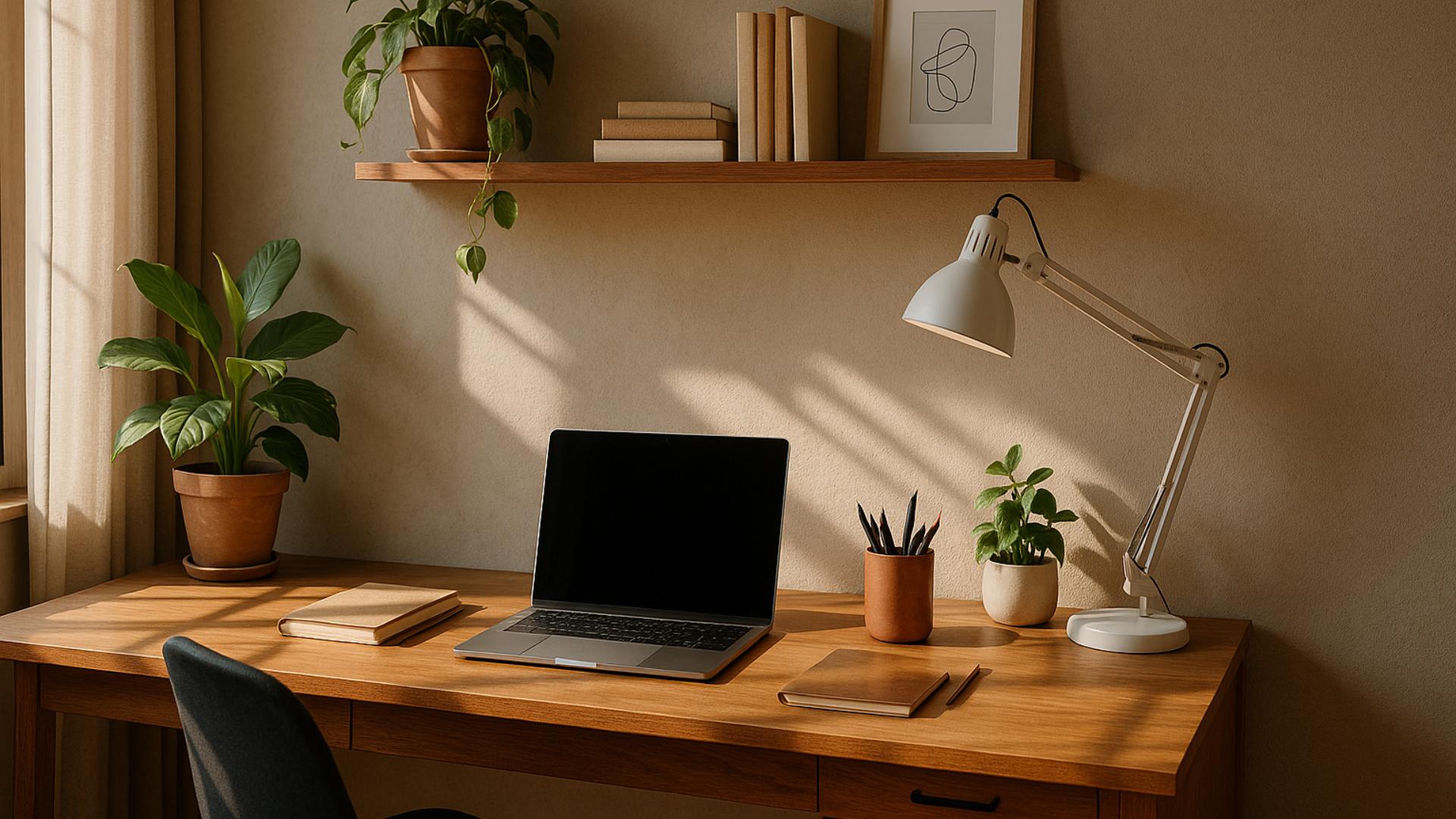
The wall behind you is a professional surface, because it appears in every video call you take. It works best plain, with one or two calm elements and nothing that generates questions. A shelf with three objects on it, a single piece of art, a wall in a mid-tone paint. Keep it uncluttered and, if you can, keep the doorway out of shot.
Sound is the variable nobody budgets for
A converted spare room is usually a hard box: laminate or timber floor, plasterboard walls, a desk, and very little soft material. That produces a long reverberation, which makes your voice harsh on calls and makes concentration harder in a way that people rarely attribute to the room.
Soft mass is the fix, and it needs to be distributed rather than concentrated in one corner. A rug with an underlay, full-length curtains even where the window does not need covering, an upholstered chair rather than a hard-shell one, and books on open shelving, which scatter sound rather better than a flat panel. Noise-cancelling headphones are a reasonable tool for outside noise and do nothing at all for the acoustics of the room you are speaking in.
A room that inspires also has to be leavable
The failure mode of a workspace people love is that they never stop using it. If the office occupies part of a room with another function, the most useful design decision is a way to switch the room off: a desk with a surface that closes, storage that swallows the day’s paperwork in one movement, and a separate lamp that is the only light on after six.
That last one does more than it sounds like it should. Changing which light source is on changes what a room appears to be for, which is the cheapest available substitute for a door between work and home.
Three questions readers send us
Does a room without a window rule this out? No, but it changes the brief entirely. The light has to be specified rather than positioned, which means layering ambient, task and accent sources and paying attention to colour temperature through the day. Our guide to lighting an interior without windows goes through the numbers.
How many plants is enough? Enough to be visible from where you sit, which in a small room is two or three of reasonable size rather than a dozen small pots. Choose species that suit the light the room actually receives, since a struggling plant is a worse presence than no plant.
Is a plain workspace better for focus than a decorated one? The field research points the other way: the bare, minimal office was the weaker condition in all three experiments cited above. Clutter on the working surface is a different question from decoration on the walls, and it is the desk surface, not the room, that benefits from being kept clear.
Still deciding where the desk goes?
Atmosphere is the second decision. Position, ergonomics and task light come first, and in that order.
Sources: Boubekri et al., Impact of Windows and Daylight Exposure on Overall Health and Sleep Quality of Office Workers, Journal of Clinical Sleep Medicine, 2014; Nieuwenhuis et al., The Relative Benefits of Green Versus Lean Office Space, Journal of Experimental Psychology: Applied, 2014; Cummings and Waring, Potted plants do not improve indoor air quality, Journal of Exposure Science and Environmental Epidemiology, 2020.