
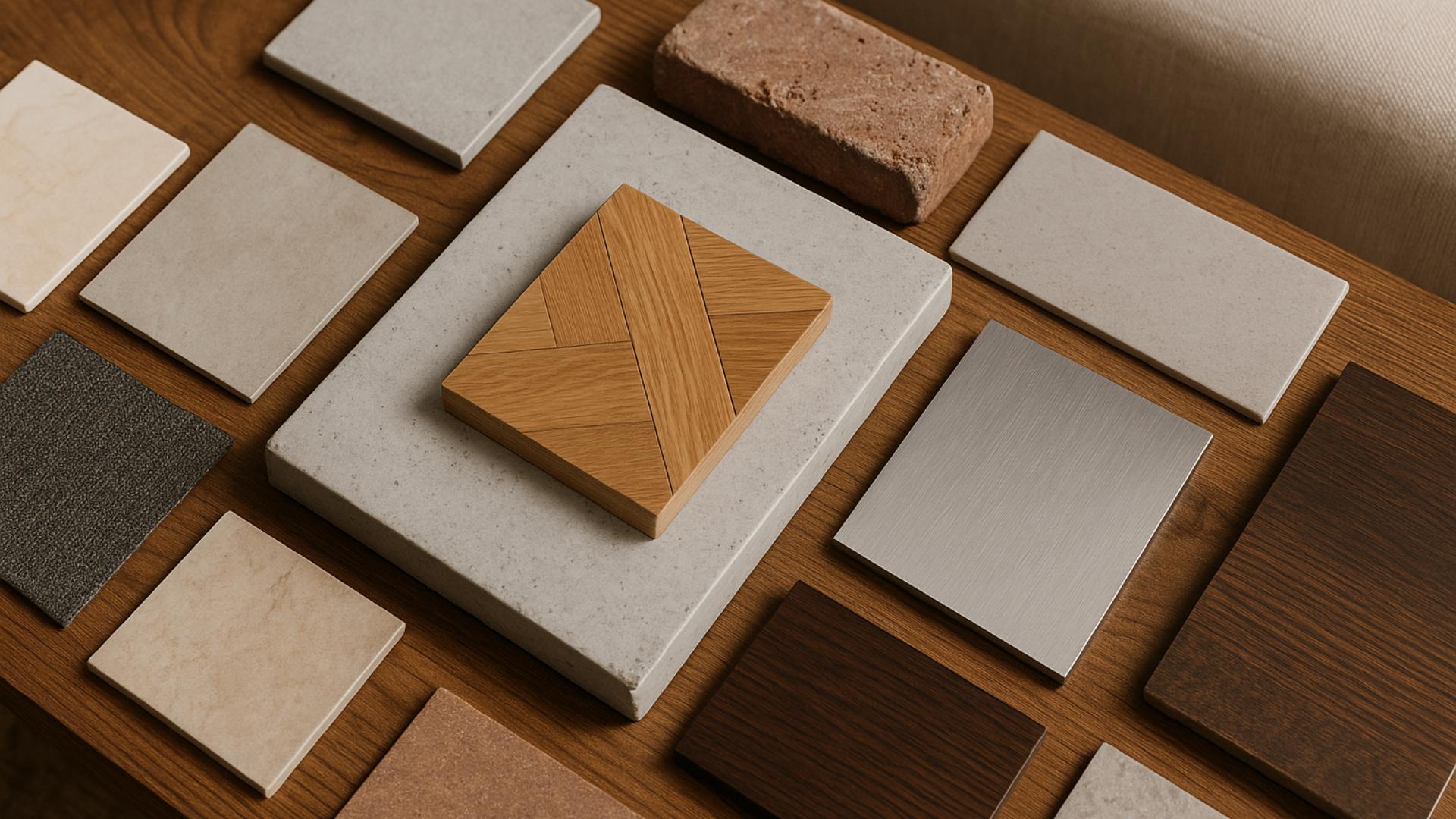
Almost every material sold for a home is described as durable, and almost none of those descriptions mean anything. The useful information is usually printed on the back of the sample board, in a code most buyers walk past: an abrasion class, a rub count, a hardness figure.
Read this before the showroom
- Ask for the classification, not the marketing copy. If a supplier cannot quote one, that itself is information.
- Classes are matched to rooms, not to houses. A hallway and a spare bedroom have nothing in common.
- The rating tests the face of the material, never the joints, edges or sealant around it.
- Repairability decides the real lifespan. A surface that cannot be refinished has one life only.
Durable is a number before it is an adjective
The classifications exist because the industry needed a way to compare surfaces without arguing about them. Each one puts a sample through a standardised, repeatable form of abuse and records the point at which it gives up. A laminate is worn by a rotating abrasive wheel; an upholstery fabric is rubbed in a figure-of-eight pattern under a constant load of 12 kPa, roughly the pressure of someone sitting down.
None of this makes the numbers infallible, and a laboratory wheel is not a dog, a bicycle or a dropped saucepan. What the numbers do is separate two products that look identical on a shelf and behave completely differently after four winters. A class is a floor, not a promise, and it is the only comparable evidence most buyers will ever be given.
The four classifications worth memorising
These four cover the large majority of surfaces specified in a domestic interior. The right-hand column is the level we would treat as the practical minimum in a home that is genuinely lived in, rather than the level a brochure suggests.
| Material | Scale and standard | What is actually measured | Sensible minimum at home |
|---|---|---|---|
| Laminate flooring | AC1 to AC5, EN 13329 | Rotations of a Taber abrasive wheel before the wear layer breaks down | AC3 throughout, AC4 in halls and kitchens |
| Glazed ceramic and porcelain tile | Abrasion class 0 to 5, EN ISO 10545-7, sold as PEI I to V | Wear of the glaze under an abrasive load | Class 4 for main circulation, class 5 where outdoor grit is tracked in |
| Upholstery fabric | Martindale cycles, EN ISO 12947-2 | Rubs to specimen breakdown at a constant 12 kPa | 25,000 to 30,000 cycles for a family sofa |
| Solid and engineered wood | Janka hardness, plus wear layer thickness on engineered boards | Force needed to embed a steel ball halfway into the timber | A denser species in circulation zones, and at least a wear layer thick enough to sand once |
One warning about the first line. The EN 13329 scale stops at AC5; anything marketed as AC6 is a manufacturer’s own claim rather than a standard class, and should be read as such. On the third line, the figure only holds if the fabric has actually been tested to the standard rather than compared to it.
Match the class to the room, not to the house
Traffic is not evenly distributed in a home, and specifying one grade everywhere means overpaying in half the rooms and under-specifying in the rest. We would map a house in three bands before choosing anything.
Entrances, halls and kitchens
These take the punishment, and the mechanism is almost always the same: grit carried in on shoes, acting as an abrasive under pressure. That is the exact failure mode the AC and PEI scales are built to measure, which is why the top of the range belongs here and nowhere else. A good doormat run of two metres does more for a floor than one class step upwards, and costs a fraction of it.
Bedrooms, studies and spare rooms
Low traffic, usually socked feet, very little grit. Paying for a commercial-grade class in a bedroom buys nothing you will ever notice. Spend the difference on the surfaces you touch daily instead, or on a better underlay, which affects how a floor sounds and feels far more than its abrasion class does.
Bathrooms and wet zones
Here the abrasion class is the least important number on the sheet. What matters is water absorption and, above all, slip resistance, which is a separate rating again: the R9 to R13 ramp classification, or a pendulum test value, depending on the market. A tile can be class 5 for wear and still be genuinely dangerous wet, and the two numbers have nothing to do with one another.
Where the ratings quietly stop telling the truth
Every one of these tests is performed on the face of a material, in the middle of a sample, in laboratory conditions. Real interiors fail at their edges. Grout lines discolour long before a class 5 tile shows wear. A laminate with an immaculate surface swells at a board joint after one dishwasher leak. Upholstery rated for 40,000 cycles splits at a seam, not in the open field the Martindale machine tested.
The practical consequence is that the assembly deserves as much attention as the material. Joint width and grout type, edge trims, the sealant behind a worktop, the underlay beneath a floor: none of them appear in any class, and all of them decide when the surface starts to look tired. The same logic applies to raw finishes, where the mistakes tend to be about protection rather than product, as we set out in our piece on common errors with raw material decoration.
The question no classification answers
Ask whether the surface can be repaired without being replaced. It is the single question that separates a fifteen-year interior from a five-year one, and no standard covers it.
Solid timber can be sanded and refinished several times over its life, which is why a softer species with repairability can outlast a harder one without it. Engineered boards can take one or two passes if the wear layer is thick enough, and none at all if it is a veneer. Laminate cannot be refinished at all, though a single plank can often be swapped if you kept spares from the original batch. Stone and concrete can be honed back. Loose covers on a sofa can be replaced for a fraction of the price of the sofa; fixed upholstery cannot.
Keep spare material. One box of tiles, two planks, a metre of fabric, stored flat and labelled with the batch number. Colour batches change, ranges are discontinued, and a repair made from the original batch is invisible in a way a close match never is.
What we get asked once the spec sheet runs out
Is a higher class always worth the extra money?
Only where the failure mechanism it measures is present. In a hallway, moving from AC3 to AC4 buys real protection against tracked-in grit. In a bedroom, the same step buys a number on a box. Spend where the abrasion actually happens.
Does an expensive material automatically last longer?
No, and price and class are only loosely related. Cost often reflects appearance, thickness, provenance or brand rather than measured resistance. Two floors at the same AC class can differ by a large margin in price and by very little in how they wear.
What if a supplier cannot give me a classification?
Treat the absence as an answer. Any manufacturer selling laminate, glazed tile or contract upholstery in Europe will have the test data, because their trade customers require it. A retailer who cannot produce it is either selling an untested product or does not know what they are selling.
Do these classes apply to natural stone?
Not directly. Stone is generally assessed through hardness, porosity and, for flooring, slip resistance rather than through a single abrasion class. A porous limestone and a dense granite behave very differently in a kitchen, and the relevant figure there is water absorption, not wear.
How much does maintenance change the outcome?
Substantially, and mostly through grit removal. Regular vacuuming of hard floors, entrance matting, felt pads under furniture and prompt attention to spills will extend the life of a mid-class material past a neglected high-class one. Maintenance is not a substitute for correct specification, but it routinely outweighs one class step.
Specify with the number in front of you, install with the joints in mind, and keep the offcuts. That combination will do more for the lifespan of an interior than any material choice made on appearance alone.
Choosing the floor first?
Flooring is where these classifications bite hardest, and where the differences between rooms are widest.