
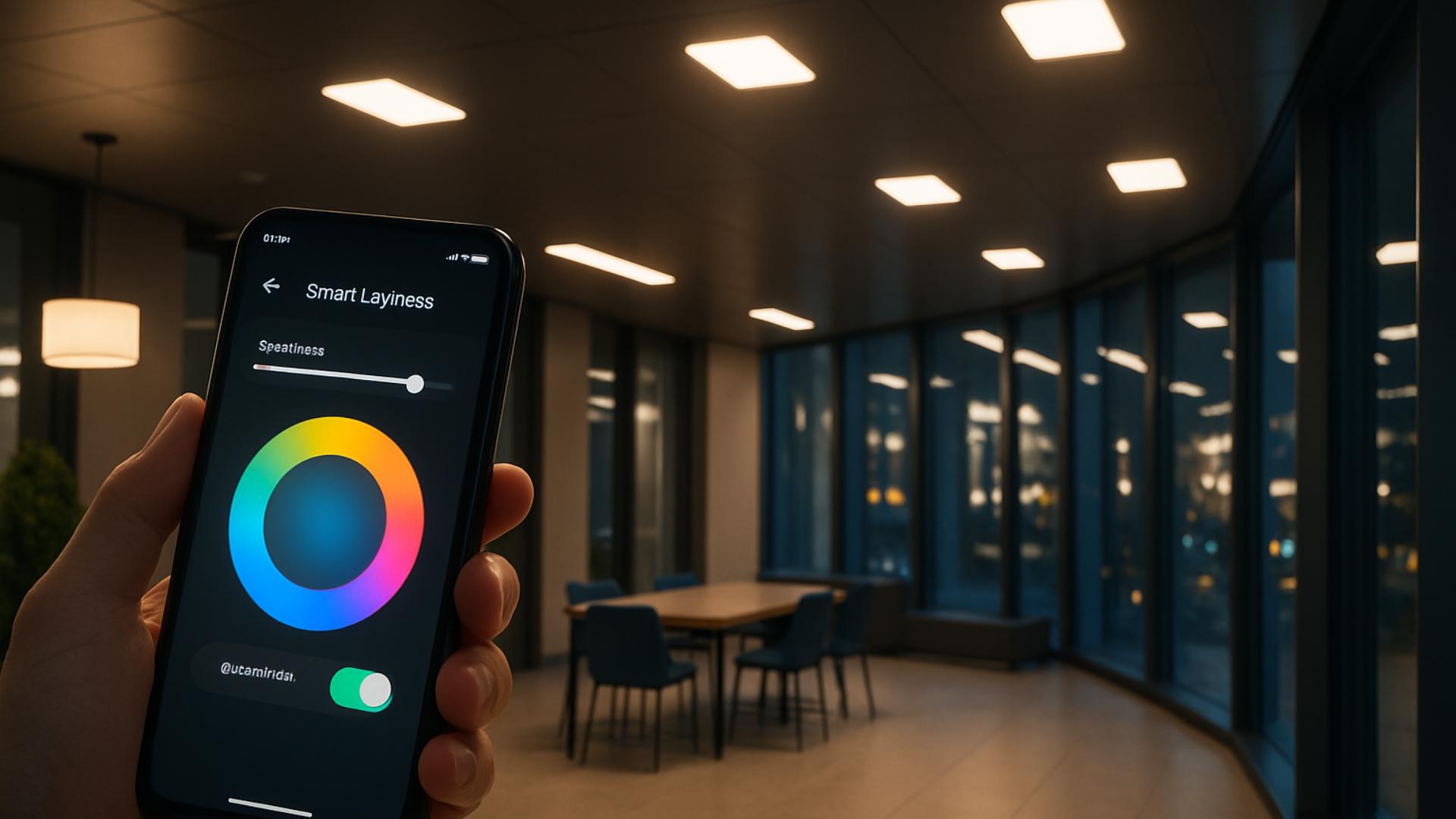
Every smart lighting proposal opens with a savings percentage, and that figure is usually the least dependable line in the document. The technology itself is mature. What varies, sometimes by a factor of two between two apparently comparable buildings, is how much of the promised saving is still there a year after handover.
Settle these before the tender goes out
- The saving comes from the control strategy, not from the LED. Occupancy response, daylight response and task tuning do almost all of the work.
- The control protocol will outlive two generations of fittings, so it is a long-term architectural commitment rather than a supplier preference.
- Illuminance targets are set by standard, not by taste, and the European reference was revised in 2021.
- A connected luminaire is a networked device with a data output. It belongs on the security register and, in Europe, in the data protection conversation.
Where the saving actually comes from
Four control strategies account for the bulk of measured reductions, and they behave very differently depending on how a building is occupied. Lighting represented roughly 10% of total energy use across US commercial buildings in the 2018 Commercial Buildings Energy Consumption Survey published by the Energy Information Administration, so the absolute prize is real but finite. Overstating it is what turns a sound project into a disappointed client.
| Strategy | What it does | Where it pays best |
|---|---|---|
| Occupancy and vacancy sensing | Switches or dims a zone when nobody is present | Intermittently used space: circulation, meeting rooms, warehouses, sanitary areas |
| Daylight response | Trims artificial output as daylight rises | Perimeter zones, atria, glazed facades, top-lit floor plates |
| Task tuning | Caps output at the level the task genuinely needs | Buildings over-lit at design stage, which is most refurbishments |
| Scheduling and load shedding | Aligns lighting with operating hours and tariff signals | Estates with predictable hours and demand-based energy contracts |
Notice what is missing from that table: the luminaire. Replacing a fluorescent fitting with an LED equivalent produces a one-off reduction and then stops. Everything that keeps improving afterwards comes from the control logic and from someone being paid to revisit it. Lighting is the easiest system on which to demonstrate this discipline, which is why it often becomes the pilot for the wider programme described in our guide to best practices for implementing building energy management systems.
The protocol decision outlives the fittings
Specify a protocol, not a manufacturer. DALI remains the reference for addressable commercial lighting, and the DALI Alliance extended it in 2019 with D4i, which standardises data exchange inside the luminaire itself, including energy and diagnostic reporting. The Alliance has since published gateway specifications covering Bluetooth mesh to DALI and Zigbee to DALI, so a wired DALI-2 or D4i installation can be driven from a wireless ecosystem rather than being replaced by one. KNX plays a comparable role where lighting sits alongside blinds and HVAC on a single bus.
Matter, the residential interoperability standard backed by Amazon, Apple, Google and Samsung through the Connectivity Standards Alliance, reached version 1.4 in late 2024 and has done a great deal to unify the consumer market. It has not displaced DALI or KNX in commercial specification, and treating the two worlds as interchangeable is a recurring source of trouble on mixed-use schemes.
Light quality is written into the specification, not discovered afterwards
The illuminance a space needs is a published requirement, not a design opinion. In Europe, EN 12464-1 was revised in 2021 and sets 500 lux as the maintained level for standard office task areas, with modified higher values of 750 or 1,000 lux where occupants are older or the visual task is fine, alongside a minimum uniformity of 0.4 across the task area. Other jurisdictions apply their own equivalents, so a specification written for a European headquarters cannot be copied unchanged into a project elsewhere.
Tunable white lighting, which shifts colour temperature across the day, is where claims currently outrun the evidence. Field evaluations are still accumulating, and the sensible position for a specifier in 2026 is to treat measurable outcomes such as illuminance, uniformity and glare control as contractual, and wellbeing claims as an aspiration that nobody should be asked to guarantee.
What a connected luminaire adds to the risk register
Once a fitting has an address, an IP path and a sensor, it stops being purely an electrical item. Three consequences follow, and none of them is usually priced in the lighting package.
- Network exposure. Lighting controllers belong on a segmented network with the same patching discipline applied to any other operational technology, not on the general office VLAN because that was the socket available.
- Occupancy data. Presence sensing generates a record of who was where and when. Where that record can be tied to identifiable individuals, European data protection rules apply, and in several countries the employee representation conversation has to happen before commissioning rather than after.
- Support horizon. LED fittings are commonly rated for tens of thousands of operating hours. Software support windows are far shorter, so ask in the tender how long firmware updates are guaranteed and what happens to the installation when the vendor’s cloud service is retired.
Three questions that come up at tender stage
Can this be retrofitted into an occupied building? Usually yes. Wireless control and luminaire-level electronics were developed largely to avoid recabling, and phased floor-by-floor works are the norm. The constraint is rarely the hardware, it is the commissioning window and the availability of someone who can tune the sequences once people are back in the space.
Does it work with Alexa or Google Assistant? In apartments and small offices, yes, through a hub or a Matter-certified device. On a commercial estate this is the wrong question. What matters is the interface to the building management system and the ability to export energy and occupancy data in a format your own team can read.
Does simulated occupancy deter intruders? Pattern-based lighting while a building is empty is a reasonable low-cost measure and it is widely used, but we have seen no robust data quantifying its deterrent effect. Treat it as a useful habit, never as a substitute for a specified security system.
Looking at the wider building systems package?
Lighting and access control raise the same questions about protocols, data and who owns the system after handover.
Sources: DesignLights Consortium, Energy Savings from Networked Lighting Control Systems with and without LLLC (2020) and clarification memo (January 2025); US Energy Information Administration, Commercial Buildings Energy Consumption Survey (2018); DALI Alliance specifications for D4i and wireless-to-DALI gateways; EN 12464-1:2021.