
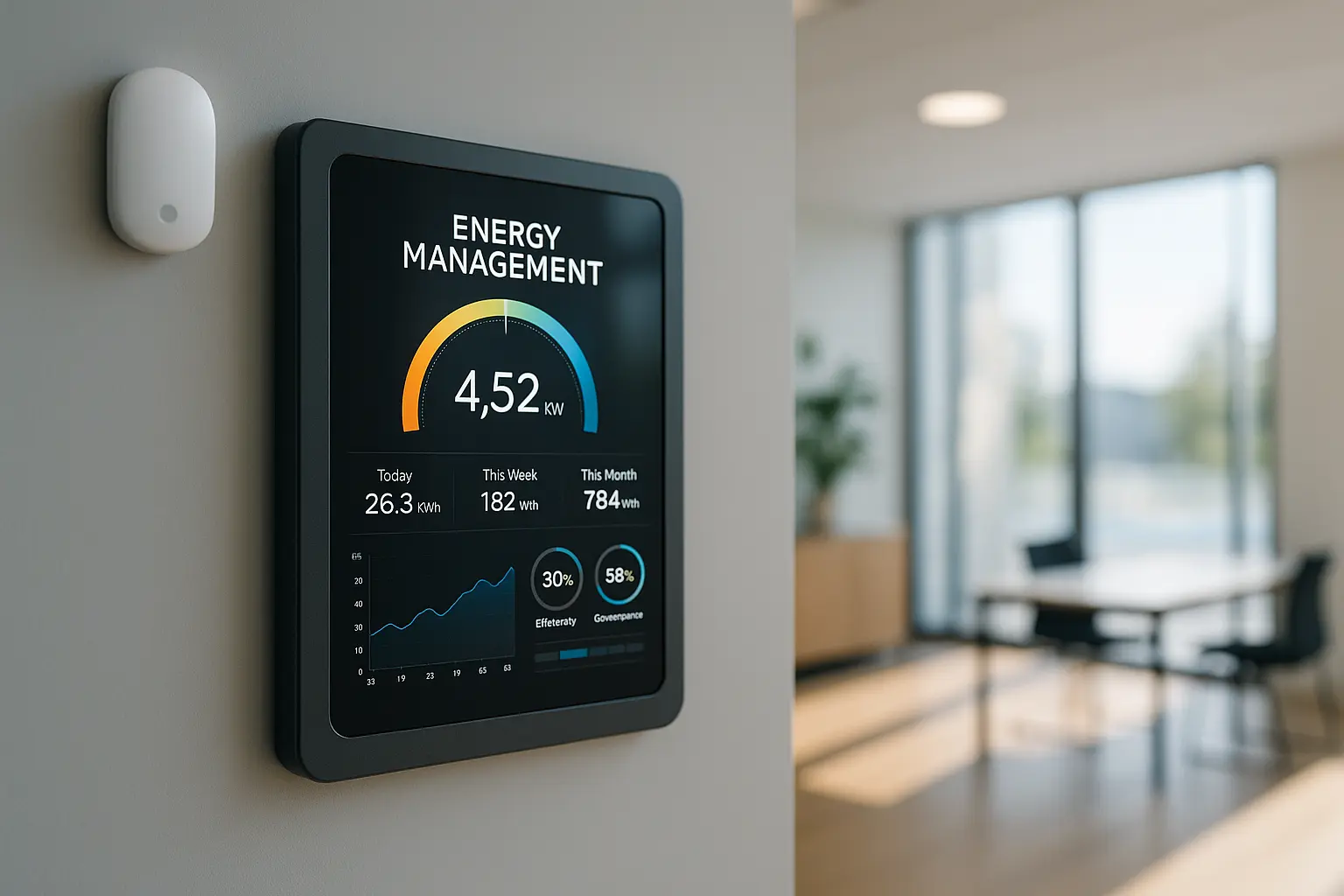
For a large part of the European non-residential stock, installing a building energy management system stopped being a discretionary investment some time ago. It became a legal requirement with a date attached, which changes how the project should be run.
Four practices that decide the outcome
- Baseline first: without twelve months of metered data, savings cannot be proven or defended.
- Specify interoperability explicitly, because the EU framework now requires it and procurement rarely enforces it.
- Control sequences, not sensors, are where the savings are won or lost.
- Performance drifts. A system nobody re-commissions loses most of its benefit within a few years.
Start from the obligation, then build the business case
In the European Union, the trigger is regulatory. Under the recast Energy Performance of Buildings Directive, Directive (EU) 2024/1275, non-residential buildings with an effective rated output above 290 kW for heating, air conditioning or the combined systems were required to be fitted with building automation and control systems by 31 December 2024, and the same obligation extends to buildings above 70 kW by 31 December 2029 (Article 13(9)). Member States had until 29 May 2026 to transpose the revised directive into national law, so the applicable national rules are what a project team should be reading, not the directive alone.
Outside the EU the driver is commercial rather than statutory, and the framing changes accordingly. What does not change is the underlying arithmetic: buildings account for around 30% of global final energy consumption and more than half of global electricity consumption, according to the International Energy Agency’s 2025 energy efficiency policy work. In a portfolio of any size, that is a cost line worth instrumenting properly.
A baseline you can defend
The most common reason a BEMS project cannot demonstrate its value is that nobody recorded what the building did beforehand. A defensible baseline means sub-metered consumption over a full annual cycle, weather-normalised, with the major end uses separated. Without it, every subsequent claim of improvement is an argument rather than a measurement.
This is also the point at which the scope becomes honest. An audit against a recognised framework such as ISO 50001, the international standard for energy management systems, tends to reveal that a meaningful share of the available saving sits in scheduling, setpoints and maintenance rather than in new hardware. Knowing how a system’s monitoring and control loop actually functions is worth settling before the tender documents are written, and our explainer on how energy management systems work covers that ground.
Specify interoperability, not a supplier
The single most expensive mistake in this field is a closed system. A BEMS installed today will outlive several generations of the equipment connected to it, and the building will change hands, tenants and plant during its life. Specifying open communication protocols, BACnet (standardised as ISO 16484-5) and Modbus being the usual candidates, keeps future replacement a competitive exercise instead of a negotiation with one vendor.
The EU framework now says something similar. Article 13(10) of the recast directive requires that such systems be capable of continuous monitoring and logging of energy use, of benchmarking efficiency, of interoperability across different technologies and manufacturers, and, from 29 May 2026, of monitoring indoor environmental quality. That last addition matters: it pulls comfort and air quality into a scope that used to be about kilowatt-hours alone.
| Failure mode | How it shows up | What prevents it |
|---|---|---|
| No baseline | Savings disputed at review | Twelve months of sub-metered data |
| Proprietary lock-in | Single-bid maintenance renewals | Open protocols written into the tender |
| Sequences left as default | Plant runs against itself | Documented, reviewed control logic |
| Alarms nobody answers | Hundreds of ignored notifications | Prioritised alarms with named owners |
| Handover as endpoint | Performance drift after year two | Budgeted ongoing commissioning |
The savings live in the sequences of operation
Sensors generate data; sequences generate savings. Heating and cooling fighting each other in the same zone, ventilation running against an empty floor, setpoints widened during a complaint and never reset: these are logic problems, and no amount of additional instrumentation fixes them.
This is why ASHRAE Guideline 36-2021, High-Performance Sequences of Operation for HVAC Systems, has become a useful reference point even outside North America. It gives a project team a documented, reviewable set of sequences to specify against, instead of accepting whatever default logic a contractor’s library happens to contain. Published estimates of the savings vary widely with building type and baseline, which is precisely why the metered baseline described earlier matters.
Handover is the middle of the project
Control performance degrades. Overrides accumulate, occupancy patterns change, sensors drift out of calibration and nobody notices because the dashboard still shows green. Treating commissioning as a recurring activity rather than a milestone is what keeps the second and fifth years looking like the first.
Practically, that means a named owner for the system inside the organisation, a short list of alarms that genuinely require a response, and a scheduled review of trend data against the baseline. Automated fault detection helps, but only where someone is accountable for acting on what it finds.
Questions that come up during procurement
What should be done before approaching suppliers? A metered baseline and an energy audit. They define the scope, they set the reference against which any later claim is judged, and they usually shift part of the budget from hardware to operational fixes.
Does the EU threshold apply to our building? It depends on the effective rated output of the relevant heating, ventilation and air conditioning systems, and on how the directive has been transposed nationally. The thresholds above are those set out in Directive (EU) 2024/1275; national implementing rules are the operative text.
How much of the saving is behavioural? Enough that it should be planned for. Occupant engagement and clear feedback on consumption tend to hold gains that purely technical measures give back over time.
Is artificial intelligence changing this? Machine-learning approaches to control are an active research area with encouraging published results, but they remain less proven in operation than well-specified conventional sequences. We would treat them as a supplement to a properly commissioned system, not a substitute for one.
Where this fits in the wider picture
Energy management is one strand of a broader shift in how commercial buildings are instrumented and operated.