
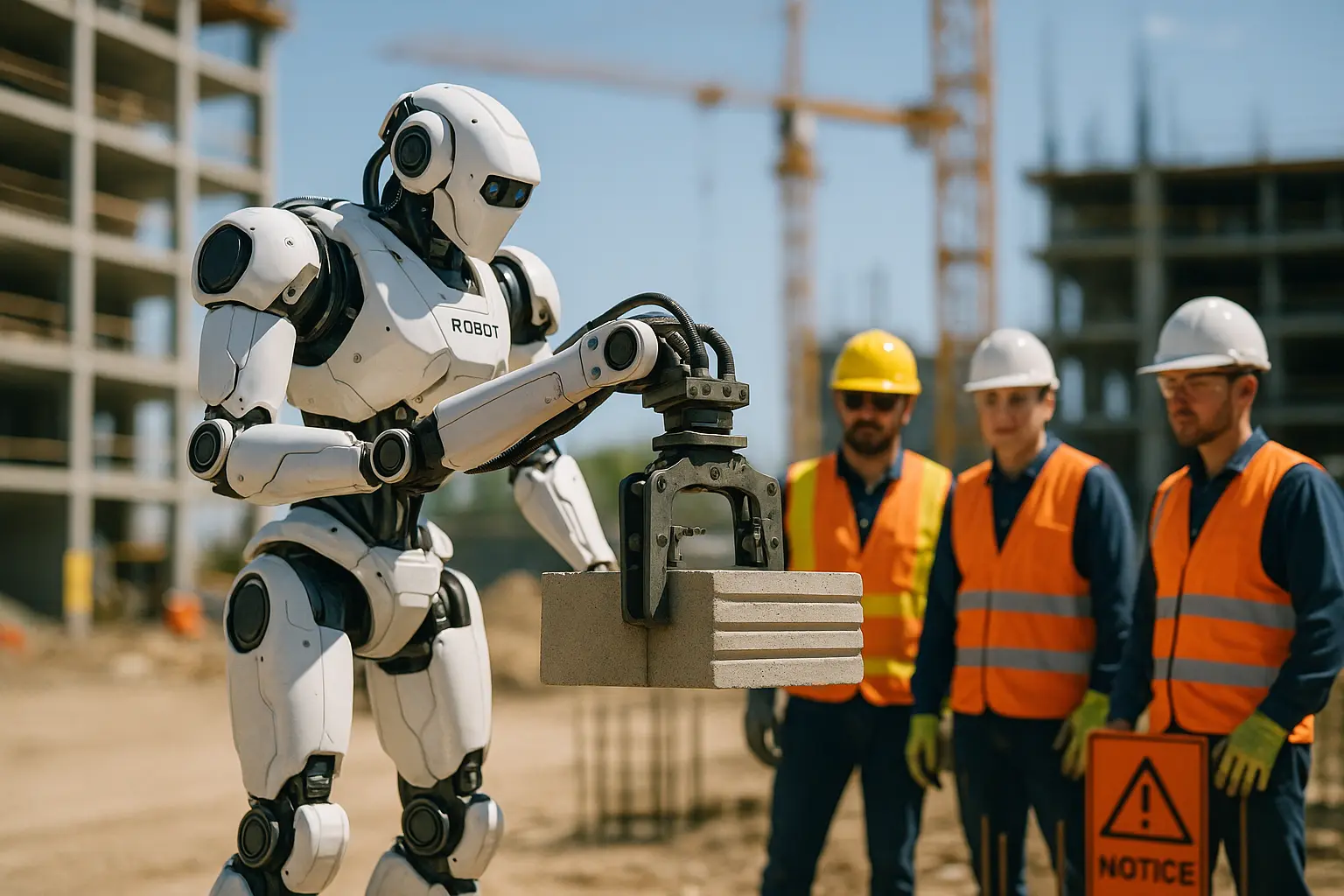
Automation is sold to contractors as a way of taking people out of harm’s way. That is half true, and the half that gets left out is the one worth planning for: most of what arrives on site moves risk somewhere else rather than removing it.
What this comes down to
- Choose the technology from the hazard register, not from the vendor demonstration.
- Every autonomous machine needs a defined exclusion zone and someone competent watching it.
- Exoskeletons and collaborative robots now sit inside published safety standards. Check which one a supplier is claiming conformity with.
- None of this replaces statutory training, PPE or the local health and safety regime.
Start from the hazard register, not the equipment catalogue
The useful question is not what a robot can do, but which of your recorded near misses it would have prevented. Construction remains one of the most dangerous sectors in most economies, and the pattern of how people get killed is stubbornly consistent. The US Bureau of Labor Statistics, in the Census of Fatal Occupational Injuries covering 2024 and released in February 2026, counted 1,034 fatal injuries among construction workers, with falls, slips and trips the largest single category across the economy at 844 deaths. Comparable national datasets differ in method and definition, so those figures should be read as an indication of where the risk concentrates rather than as a global benchmark.
Read that way, the ranking tells you where automation earns its place. Height, moving plant and repeated manual load are the three families of hazard where taking a person out of the exposure changes the outcome, and they are precisely the ones current equipment addresses best. Everything else on a typical register, from confined spaces to services strikes, is barely touched by the technologies being marketed for it.
| Hazard | What automation genuinely removes | What it puts in its place |
|---|---|---|
| Working at height | Survey, facade and roof inspection trips | Airspace management, overflight of occupied areas |
| Demolition and excavation | Operator presence in the collapse or strike zone | Remote operators with degraded situational awareness |
| Repetitive manual handling | Cumulative load on backs and shoulders | Load transferred to other joints, restricted escape movement |
| Material transport across site | Some vehicle and pedestrian interactions | Machines that move without a visible driver to make eye contact with |
| Repetitive high-precision work | Fatigue-driven error late in a shift | Stored energy, pinch points, maintenance access |
The hazards that arrive with the machine
Every automated system brings its own failure modes, and they tend to be unfamiliar to crews trained on conventional plant. Four come up repeatedly on sites that have gone through the transition.
- Movement without a driver. Site traffic management has always relied on a human in a cab who can be waved at. An autonomous dumper or a tracked survey robot removes that channel, which is why segregated routes and physical exclusion zones matter more, not less, once the driver is gone.
- Automation complacency. A system that performs well for months trains its supervisors to stop checking it. This is the most predictable failure in the whole category, and the only defence is a verification step that stays in the routine even when it feels redundant.
- Maintenance and stored energy. Hydraulics, batteries and tensioned components on robotic plant hold energy that has to be isolated before anyone reaches in. Lock-off procedures written for conventional plant rarely transfer cleanly.
- Loss of control and connectivity. Remote and semi-autonomous equipment depends on a link that can drop. What the machine does on losing that link should be a documented, tested behaviour rather than an assumption.
None of these is an argument against the technology. They are an argument for treating a first deployment as a change to the safety management system rather than a purchase.
Exoskeletons and collaborative robots: what the standards now say
The standards landscape has matured faster than the equipment. ISO 10218-1:2025 and ISO 10218-2:2025, published in 2025, replaced the 2011 versions and absorbed the collaborative-operation content that previously sat in the technical specification ISO/TS 15066, which matters if a supplier is still citing the older documents. For wearable assistance, ASTM Committee F48 has been developing consensus standards for industrial exoskeletons and exosuits since its formation in 2017, covering safety, performance and terminology.
Practically, that gives a procurement team a question worth asking before anything reaches site: which published standard is this equipment declared against, and does the declaration cover the way we intend to use it. A robot certified for a fenced industrial cell is not automatically suitable for shared space on an active site.
Maturity varies enormously across the category. Bricklaying and rebar-tying robots, autonomous plant and site-scanning units are in genuine commercial use, while much of what is demonstrated at trade shows remains at pilot stage. Our overview of how automation compresses build programmes covers the productivity side of the same equipment.
What does not change, whatever you install
The statutory obligations sit on the employer and the principal contractor, and no equipment transfers them. Induction, competence, permit-to-work systems, PPE and the duty to assess risk before work starts all continue to apply, and they apply to the automated equipment itself as much as to the work around it.
Two additions are worth building in from the start. Everyone working near an automated system needs a specific briefing on its behaviour, including what it does when it fails, and that briefing needs repeating for every new crew and subcontractor. And the operator or supervisor of the system needs documented competence for that system rather than a general plant qualification.
Construction health and safety is heavily regulated, and the detail varies by country and often by region. This article is general information about a technology trend, not a compliance guide. Confirm your obligations with the health and safety authority with jurisdiction over the site and with your own competent safety adviser before changing any method of work.
Questions that come up on first deployments
Does automation reduce headcount on site?
It changes the mix more than the total, at least at current adoption levels. Roles shift towards operating, supervising and maintaining equipment, which is why training budgets tend to rise alongside the capital cost rather than fall with it.
Do exoskeletons need a risk assessment of their own?
Yes. A device that redistributes load also constrains movement, changes how someone recovers balance, and can complicate rapid escape. Trials should cover the specific tasks and postures of the job, and should include how the wearer gets out of the device quickly.
What is the realistic first step for a contractor with no automation on site?
A single, bounded application tied to a hazard already on the register, run as a documented trial with a defined review point. Deploying one system properly teaches an organisation more about its own procedures than a broad rollout does.
Who is liable when an autonomous machine causes an incident?
Liability follows the same duties of care and product-safety regimes as any other plant, allocated between employer, operator, manufacturer and integrator according to jurisdiction and to the contract. It is a question for legal advice on the specific contract, not one with a general answer.
Wondering which of these systems are actually in service?
Our review of robotics on live construction projects separates the equipment being used commercially from what is still at pilot stage.