
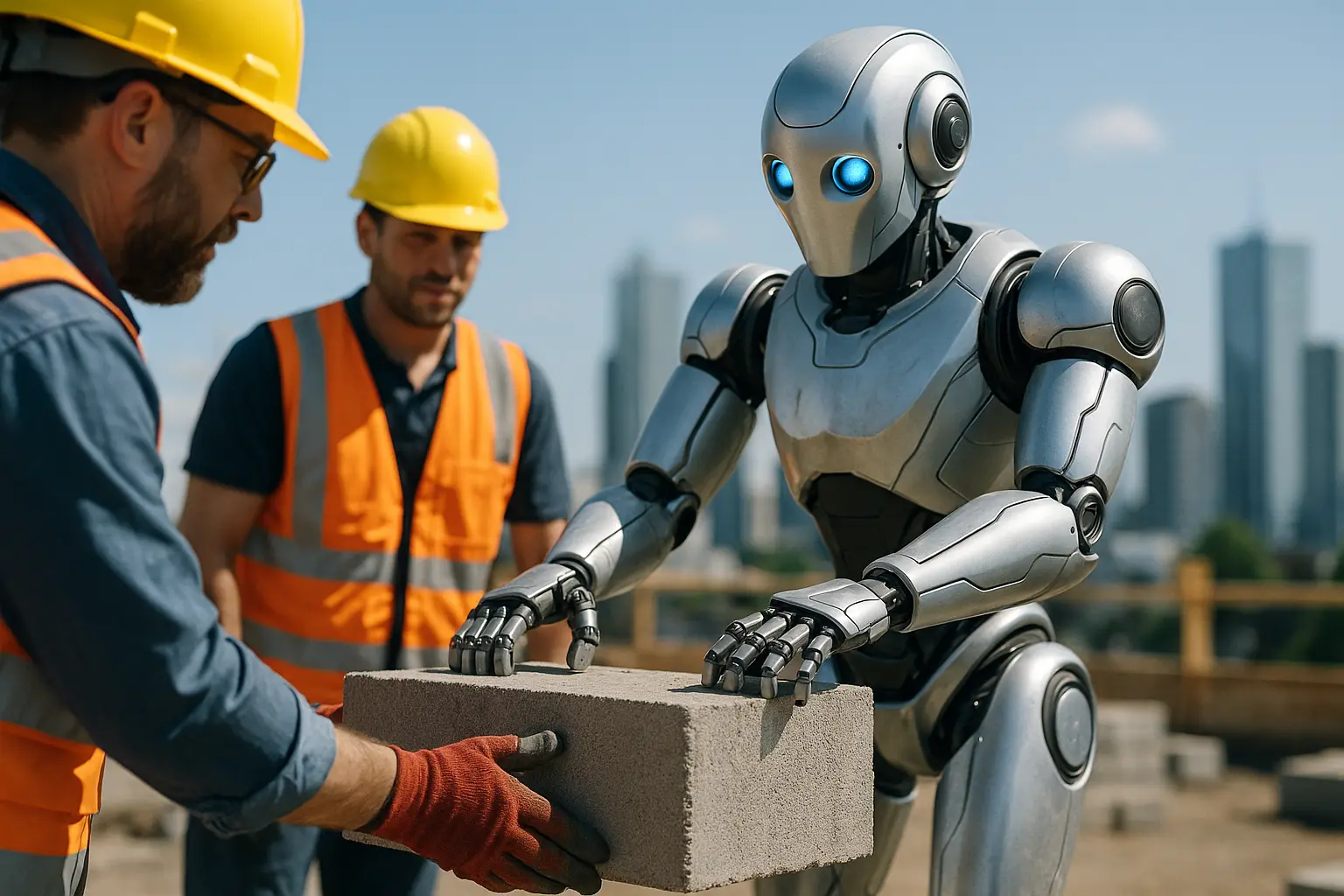
Most of the machines presented as collaborative robots on construction sites are not collaborative robots at all in the sense the safety standards use. That is not pedantry: the distinction decides which rules apply, what the insurer expects, and how the work is organised around the machine.
What holds up under scrutiny
- ISO 10218-1:2025 and ISO 10218-2:2025 replaced the 2011 texts and folded in ISO/TS 15066.
- Four workflows account for most real deployment: layout, groundworks, rebar and inspection.
- Robotics is still a rounding error in construction spend, which sets the honest scale of the change.
- The labour shortage, not the technology, is what keeps the business case alive.
What “collaborative” means once a standard is involved
A collaborative application is defined by how the robot and the person share space, not by the shape of the machine. The relevant framework changed recently and materially: ISO 10218-1:2025 and ISO 10218-2:2025 came into force on 1 April 2025, the first substantive revision of the core industrial robot safety standards since 2011. The requirements previously published separately as ISO/TS 15066, covering power and force limiting among other things, were brought into the series, and cybersecurity and functional safety requirements were added.
One terminology change is worth registering because it will surface in specifications and tender documents. The revised standards avoid the phrase “collaborative robot” in favour of collaborative application, on the reasoning that only an actual installation, designed, assessed and tested in context, can be verified as safe for shared working. No robot is collaborative on its own. It becomes part of a collaborative application, or it does not.
Applied to construction, that reframing is clarifying. A rebar tying robot crossing a mat under an operator’s supervision is not sharing a workspace in the standards sense. A robotic arm handing components to a fitter inside a prefabrication cell may well be. Both are legitimate uses of automation; only one raises the questions the collaborative provisions were written for.
Where deployment is genuinely repeatable
The Construction Robotics Report 2026, published in March 2026 by Zacua Ventures with Hilti Ventures and 94 Ventures, is useful precisely because it separates repeat deployments from pilots. Its finding is that four workflows have reached repeatable production use with measurable returns, while others remain earlier in the curve.
| Workflow | What the machine does | Maturity in 2026 |
|---|---|---|
| Layout and setting out | Marks full-scale layout from the BIM model | Repeat production use |
| Groundworks, earthmoving | Autonomous piling and trenching, notably on solar farms | Repeat production use |
| Structural, rebar | Ties intersections across large slabs and mats | Repeat production use |
| Inspection, digital capture | Drone and mobile scanning into structured project data | Repeat production use |
| MEP drilling, finishes, façade | Overhead drilling, drywall finishing, panel installation | Pilot to early production |
Two things follow from that list. The successful workflows are all repetitive, geometrically defined and physically punishing, which is exactly the profile where a machine outperforms a person over a full shift. And they are owned by specialist contractors who carry the same scope from project to project, giving them enough repetition to justify a deployment playbook. A general contractor renting a robot for one job rarely gets there.
Keep the scale honest
The same 2026 report puts on-site construction robotics at low single-digit billions of dollars globally, growing at mid-teens annual rates, and representing less than 0.03% of global construction spend. That figure is the correct antidote to the language of revolution. Growth is real, the direction of travel is clear, and the base is very small.
For anyone budgeting a project this year, the practical reading is that robotics belongs in the plan as a targeted intervention on one or two scopes, not as an operating model. The broader picture of where this is heading is worth reading alongside our overview of robotics in construction.
The factory is further ahead than the site
Off-site production is where robotics in construction is least experimental, and the reason is environmental rather than technical. A prefabrication hall offers controlled lighting, a fixed floor, known tolerances and no weather. Robotic cells reading directly from BIM models can cut, mill and assemble panels and structural components under conditions an industrial robot was designed for in the first place.
This is also where collaborative applications in the strict sense are most plausible, because a fixed cell can be designed, risk-assessed and verified once and then repeated. Recreating those conditions on a live site, where the layout changes daily and a dozen trades share the floor, is a much harder problem, and it is the honest explanation for why on-site progress looks slower than the headlines suggest.
The workforce numbers are what sustain the case
The commercial argument for construction robotics has never rested mainly on speed. It rests on the fact that firms cannot find people. In the 2025 workforce survey published by the Associated General Contractors of America with NCCER in August 2025, 92% of contractors reported difficulty filling open positions, and 45% said labour shortages were causing project delays.
Those figures are United States data and should not be read as a global statistic, though shortage of skilled trades is reported across most European markets as well. The mechanism they describe is what matters: automation is being adopted where a task cannot be staffed reliably, rather than where a robot is simply cheaper than a person.
Safety obligations do not simplify
Introducing a machine into a work area changes the risk assessment; it does not shorten it. New hazards arrive with the equipment, including moving masses, unfamiliar failure modes, and the tendency of crews to behave differently around a machine they trust more than they should.
Whatever a supplier demonstrates, site health and safety remains governed by the regulations and enforcement regime of the jurisdiction the site sits in, and by the mandatory training that goes with them. Nothing in this article substitutes for either. A robot deployment should be treated as a change to the site’s safety case, assessed by competent people, with induction for everyone who will work near it.
Questions raised on first deployments
Do these machines replace tradespeople?
On current evidence they reassign work rather than remove it. The tasks automated first are the ones with recruitment problems, and each deployment creates work in setup, supervision, data handling and maintenance that did not previously exist on site.
What size of project justifies a robot?
Repetition matters more than size. A large slab with thousands of identical operations suits automation better than a bigger but more varied job, which is why the strongest business cases sit with specialist subcontractors rather than with main contractors.
Does ISO 10218:2025 apply to a construction site?
The series governs industrial robots and their integration, so it is the reference framework for the robot itself and for the design of any collaborative application. It does not replace construction-specific health and safety law, which applies in parallel and takes precedence on questions of site organisation.
What is the most common reason a deployment disappoints?
Underestimating setup. Time spent clearing the working zone, positioning, calibrating and dealing with site conditions is the variable that turns a strong theoretical productivity gain into a marginal one, and it is rarely in the demonstration.
The wider automation picture
Robotics is one part of a broader shift in how programmes are compressed and sequenced on site.