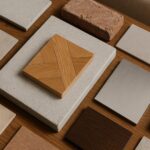

There is a wide gap between a concrete interior and a concrete feature. The first is a scheme, expensive and hard to reverse. The second is one deliberate element in a room that is otherwise plaster, timber and paint, and it is the version that works in an ordinary house.
The short version
- One feature per room. Two concrete elements in the same space read as an unfinished building site rather than a choice.
- Weight decides feasibility. A cast slab on an upper floor is a different conversation from the same slab in a ground-floor kitchen.
- Sealing is not optional on any surface that meets food, wine or citrus. Acid etches unprotected concrete permanently.
- Fine cracking and colour variation are properties of the material. If you need uniformity, choose a different material.
Why one element beats a whole scheme
A single concrete element works because everything around it provides the contrast that makes it legible. A concrete hearth in a plastered room reads as deliberate. A concrete hearth in a room with concrete floors, concrete walls and a concrete shelf reads as a surface someone forgot to finish.
The practical argument runs the same way. One element is a defined piece of work with a defined budget, a defined mess and a defined point at which it ends. It also fails gracefully: if you tire of it in eight years, you replace one object rather than a building. The full material treatment, with its three distinct techniques and their consequences, is covered in our guide to using concrete across an interior.
The five features that actually work in a normal house
Listed here by how much risk each one carries, from the most forgiving to the most committing. The weights are indicative, calculated from standard-weight concrete at around 2,400 kg per cubic metre.
| Feature | Typical build | Order of weight | How reversible |
|---|---|---|---|
| Basin or vessel sink | Precast off site, dropped in | Tens of kilos | Entirely, it lifts out |
| Coffee table, bench, planter | Precast, often glass-fibre reinforced | Tens of kilos | Entirely, it is furniture |
| Kitchen worktop | Precast slab or cast in situ | Around 90 kg per square metre at 40 mm | Replaceable, at the cost of the cabinetry beneath |
| Hearth or fireplace surround | Cast in place against the structure | Hundreds of kilos | Removable, messily |
| Stair or plinth | Cast in place, engineered | A tonne and upwards | Not in practice, it becomes structure |
The line worth pausing on is the third. A 40 mm worktop weighs in the region of 90 kg per square metre, which a run of standard cabinets will generally carry because the load spreads across the whole carcass. Go thicker, cantilever an overhang for seating, or run the slab across an island with no support in the middle, and the calculation stops being a rule of thumb.
The weight conversation nobody wants to have
Mass is the first question, not the last, and it is worth raising before anyone talks about colour. On a ground-floor slab it is rarely an issue. On a suspended timber floor, an upper storey or a period conversion, the answer comes from someone who has looked at the joists, not from a supplier’s brochure.
Two escape routes exist when the numbers do not work. Glass-fibre reinforced concrete allows much thinner sections for the same visual presence, which is how most concrete furniture and many basins are made. Microcement, applied at around 2 to 3 mm over an existing surface, adds no meaningful weight at all and no meaningful height either, which is why it survives in renovations where door clearances are already tight. Neither is a fake: they are simply the versions of the material that suit a floor that was never designed for a tonne of concrete.
Living with the surface, honestly
Concrete is porous, alkaline and reactive. Left unsealed, an acid will etch it: lemon juice, vinegar, wine and tomato all dull and pit the surface, and that damage is physical loss of material rather than a stain. It cannot be cleaned off; it has to be filled or honed back. Any concrete feature that meets food or drink therefore needs an acid-resistant sealer, applied properly and renewed at the interval the manufacturer specifies rather than when a mark finally appears.
Fine surface cracking is different, and it is not a defect. Concrete shrinks as it cures and continues to move with the building afterwards, which is why reinforcement limits crack width rather than preventing cracks. Colour will also vary across a cast piece, and the sample you approved will not match the finished element exactly. Anyone guaranteeing a crack-free, perfectly even concrete surface is describing a different product. The right response is to decide in advance whether you want the material or the photograph of it.
Making one hard element feel warm
A concrete feature needs three counterweights in the room, and the classic mistake is providing only the first. Timber handles colour temperature: an oak or walnut mass nearby stops the grey reading as cold. Textile handles sound, which matters more than people expect, because a hard mass in a room with hard floors and large glazing lengthens reverberation and makes conversation tiring. Light handles texture: raked, low-angle lighting across a concrete face brings out the surface, while flat overhead light kills it completely.
Scale is the fourth, unspoken counterweight. A concrete element should be clearly the heaviest object in the room or clearly a small object within it. Somewhere in between, it just looks like a mistake in the plasterwork.
Questions we get before anything is cast
Can a concrete feature go into a rented flat?
Only in furniture form. A precast table, bench or planter travels with you and needs no permission. Anything cast in place is an alteration to the property, and generally not one a landlord will accept.
Is precast or cast in place better?
Precast gives a more predictable result, a cleaner site and a piece made in controlled conditions. Cast in place gives continuity and shapes that cannot be delivered through a doorway. For a single feature in an existing home, precast is right far more often than not.
Does a concrete worktop work with underfloor or radiant heating?
Concrete has high thermal mass, which makes it well suited to radiant systems in a floor and slow to respond to changes in temperature. On a worktop the same property simply means the surface stays cool to the touch, which is useful for pastry and unremarkable otherwise.
How much maintenance does a sealed feature actually need?
Daily care is trivial: a neutral pH cleaner and no abrasive pads, since abrasives attack the sealer rather than the concrete. The real commitment is resealing on schedule, which is a job of an hour or two for a worktop, and an appointment most owners forget until the first etch mark appears.
Will the colour change over time?
Yes, and that is the material behaving normally. Concrete darkens slightly with use and develops a patina around the areas that get handled most. Owners who like concrete tend to like this; owners who wanted a uniform grey surface tend to be disappointed within a year.
Decide on the element, settle the weight, seal it properly and let it age. A concrete feature chosen that way stays interesting long after the trend that suggested it has moved on.
Working out where the raw materials go?
Concrete rarely stands alone. The wider industrial vocabulary sets out which materials it belongs beside, and in what proportion.