
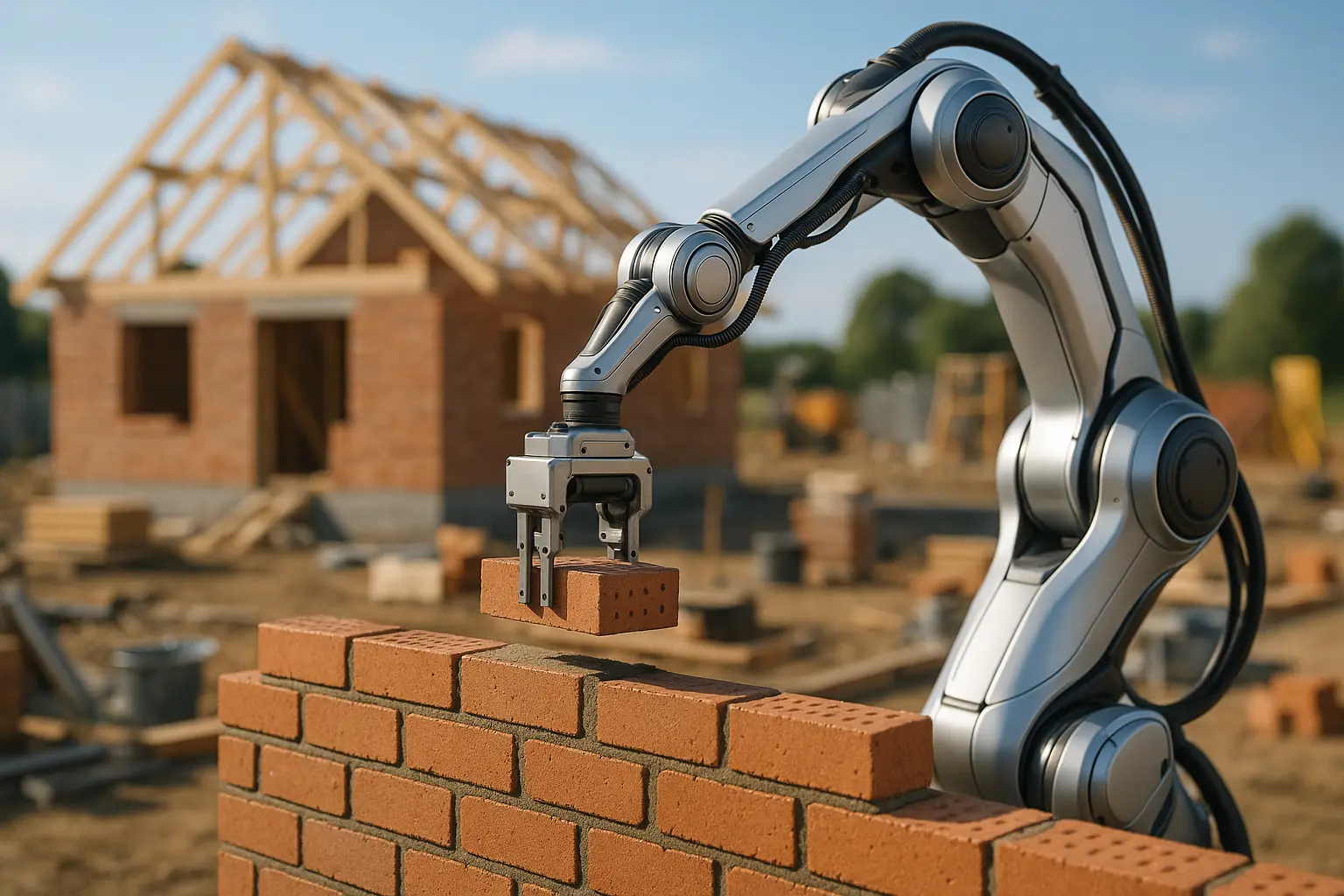
Almost every photograph of a construction robot shows it standing on a muddy site. In housing, that image is misleading. The robots reshaping how homes get built are mostly indoors, under a roof, working on a bench, and the ones that matter most to a developer’s programme never visit the plot at all.
Where this stands in 2026
- Panel and module production in a controlled space is the mature application. Free-roaming site robots are not.
- AUAR builds container-sized robotic micro-factories that cut timber wall, floor and roof panels close to where homes are needed.
- Ontario has become one of the busiest testbeds for factory-built housing in North America, backed by federal money.
- The Zacua Ventures report of March 2026 puts on-site robotics below 0.03% of global construction spend in 2025. Expectations should be sized accordingly.
Two different machines, two different economics
The distinction that decides everything is where the robot stands. A machine on a live site has to cope with weather, changing ground, other trades, and a geometry that shifts as the build progresses. The same machine bolted to a floor in a shed does none of that, and its payback arithmetic changes completely.
| Robot on the plot | Robot in a factory cell | |
|---|---|---|
| What it needs | Survey control, clear access, tolerance for site conditions | A fixed jig, consistent material, a repeated product |
| What kills the business case | Idle time between zones, one-off geometry | An empty order book, transport distance to site |
| Typical housing use | Layout, groundworks, rebar, progress capture | Timber panels, volumetric modules, pre-fitted services |
| Maturity | Narrow but real, in a handful of workflows | Commercially established, decades old in the Nordics |
That last row is worth sitting with. McKinsey’s 2019 study of modular construction found less than 4% of the United States housing stock was built modularly, against around 15% in Japan and roughly 45% in Finland, Norway and Sweden. The technology question was answered a long time ago in Scandinavia. What has changed recently is who is willing to pay for the factory.
What a micro-factory actually does
AUAR, the British firm trading as Automated Architecture, took the least obvious route into this: instead of building one enormous plant and shipping modules across a continent, it packs a robotic cell into a standard shipping container and sends the factory to the region that needs the homes. Inside, a robotic arm cuts and fixes timber into wall, floor and roof panels, with openings and service routes already accounted for.
The company works with ABB robotic arms, a partnership the two announced in March 2024, and shipped two of these micro-factories to the United States later that year to serve Midwest homebuilding. Each unit is stated by the company as capable of producing up to 180 homes a year, with a lead time of around twelve weeks from order to delivery, and it is offered on a hardware-as-a-service basis rather than as a capital purchase. Those are supplier figures rather than independently audited output, and worth treating as such.

The interesting part is not the arm. It is that the design software, the panel geometry and the machine instructions are one continuous chain. A change to a window position is a change to a cutting file, which means the customisation that traditionally blows up a factory schedule becomes cheap. That is the reverse of the old prefab bargain, where affordability was bought with identical houses.
Ontario, where the bet is being placed right now
North American momentum has concentrated in a few places, and Ontario is the clearest of them. Reporting in The Globe and Mail in July 2025 set out the shape of it: Assembly Corp acquiring the equipment of a Swedish modular plant fitted out with robotics designed by Lindbäcks, with a factory planned at Downsview in Toronto; EllisDon setting up a modular facility near Hamilton; CABN operating in Brockville with a stated capacity of around 300 four-bedroom homes a year; and Stelumar Advanced Manufacturing, founded by Mattamy Homes founder Peter Gilgan, targeting 3,000 homes annually.
Behind all of it sits a federal commitment of $26 billion aimed at raising productivity in Canadian homebuilding. Public money of that size does not guarantee the factories will fill their order books, but it does explain why so many of them appeared at once.
The numbers that should temper the enthusiasm
Two figures keep this honest. The Construction Robotics Report published in March 2026 by Zacua Ventures with Hilti Ventures and 94 Ventures put on-site construction robotics at under 0.03% of global construction spend in 2025, even while venture funding into the sector reached $1.36 billion over the first three quarters of that year. Adoption and investment are not the same curve.
The second comes from that same McKinsey work: modular delivery can be 20% to 50% faster than conventional building and save up to 20% in cost, but the study was equally clear that a badly run modular job can end up around 10% more expensive when logistics or material prices move against it. The upside is real and so is the downside, and the difference between them is usually scheduling discipline rather than technology.
Cost behaviour across automated methods generally follows the same pattern, which we have looked at in more detail in our analysis of what automation does to construction costs.
Three questions worth asking before you commit
- How many identical units does the scheme actually contain? Below roughly the volume a line needs to stay busy, the factory route adds a transport bill without buying back enough time. Count the repeats before anyone quotes.
- Who carries the design freeze? Factory production moves the decision deadline forward by months. If the client is used to changing bathroom layouts during the fit-out, that habit has to be priced or prohibited, in writing.
- What happens to warranty and spares if the supplier fails? This sector has a long record of well-funded modular firms closing mid-project. Ask what documentation, cutting files and panel specifications transfer to you, and get the answer in the contract rather than the brochure.
Site safety obligations do not soften because part of the build arrived on a lorry. Craneage, temporary works and module handling all sit under the health and safety regime of the jurisdiction you are building in, and that regime, not a supplier method statement, is the reference to work from.
The machines that do come to site
Factory cells are one half of the picture. The other is the growing set of robots designed to work alongside trades on the plot itself.
Read our review of collaborative robots on construction sites