
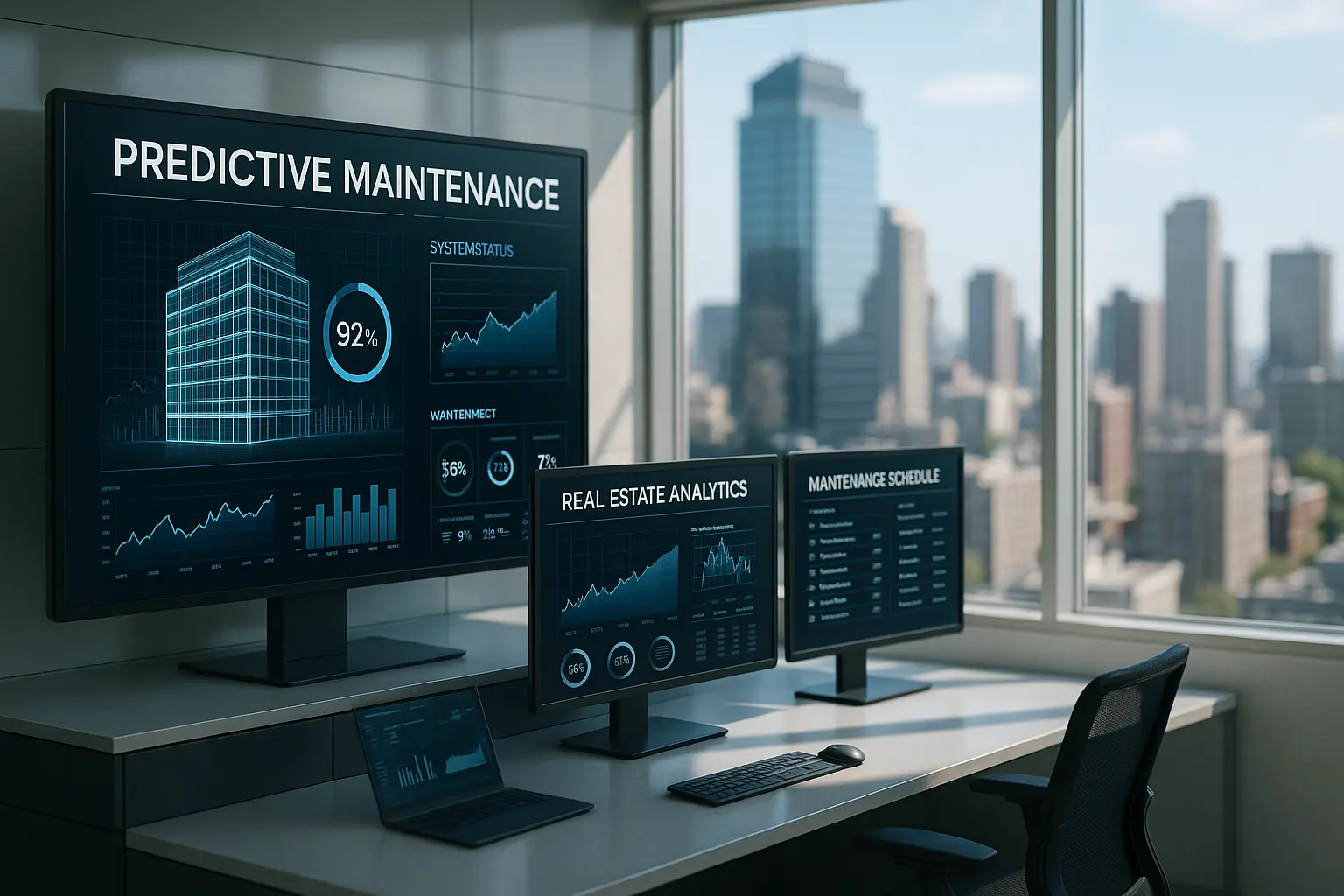
Almost every business case for predictive maintenance in property leans on the same set of percentages. Follow them back to the source and they turn out to have been measured on factory production lines, not on building portfolios. That does not make them useless. It does mean they need translating before anyone signs a purchase order.
Key points
- The regime is defined by its trigger: reactive responds to failure, preventive follows a calendar, predictive follows measured condition.
- Survey data for facilities is recent and US-weighted. The headline savings figures widely quoted come from manufacturing studies.
- Start with plant where failure is costly and instrumentation already exists, typically chillers, air handling units, lifts and pumps.
- Data quality and system integration, not sensor cost, are the usual reason a pilot never scales.
Three maintenance regimes, one difference that matters
What separates the three approaches is the trigger for sending someone to the plant room. Everything else follows from that single choice.
| Regime | Intervention trigger | Typical weakness | Best suited to |
|---|---|---|---|
| Reactive | The equipment stops | Emergency call-out rates, tenant disruption | Low-value items that are cheap to replace |
| Preventive | A date in the schedule | Servicing healthy plant, missing early faults between visits | Statutory inspections and warranty obligations |
| Predictive | A measured change in condition | Setup cost, false alerts, dependence on data quality | Critical plant that is expensive or disruptive to lose |
None of the three replaces the others outright. Statutory inspection of lifts and pressure systems remains calendar-driven regardless of what the sensors say, because the obligation is legal rather than technical. In practice a well-run portfolio runs all three at once and decides asset by asset which regime applies, which is the framing our overview of predictive maintenance in real estate sets out in more detail.
What the facilities data actually shows
Adoption in buildings is real but uneven, and the most recent survey evidence is regional. In its 2026 AI and Digitalization in Facilities Management Report, Johnson Controls surveyed 760 US business leaders and 260 US facility managers at organisations with 200 or more employees in December 2025. Among respondents already using AI, 47% of facility managers said predictive maintenance was one of the applications. Among those planning to deploy it, 52% of facility managers named predictive maintenance as a target use case.
Two caveats belong with those numbers. They are self-reported, and they describe large US organisations, so they say little about mid-sized European or Asian portfolios. What they do establish is that predictive maintenance is now the single most common reason a facilities team reaches for this class of technology, rather than an experimental corner of the market.
Where the famous savings percentages come from
The figures that circulate in vendor material, commonly cited as a reduction of around 70% in unexpected breakdowns and 25% to 30% in maintenance costs, trace back to a Deloitte Analytics Institute position paper on predictive maintenance. That work is grounded in industrial and manufacturing assets: machines that run continuously, are heavily instrumented, and whose stoppage halts production with an immediately calculable cost.
A commercial building differs on all three counts. Plant cycles seasonally, instrumentation is patchy in older stock, and the cost of a failure is spread across tenant satisfaction, energy waste and lease negotiations rather than concentrated in a stopped line. Transferring the manufacturing percentages to a property portfolio is an assumption, not a finding, and it is worth saying so in an investment committee paper rather than discovering it afterwards.
Which assets repay the sensors first
The order of deployment matters more than the technology chosen. Assets qualify when failure is expensive, degradation is gradual enough to be detected, and a measurable signal already exists.
- Chillers and air handling units. Vibration, pressure differential and power draw all drift measurably before failure, and comfort complaints follow within hours of a loss.
- Lifts. Door cycles and motor current are already logged by most modern controllers, so much of the data exists before any project starts.
- Pumps and circulation systems. Bearing wear and cavitation produce clear early signatures, and a failure can affect heating across a whole building.
- Electrical distribution. Thermal monitoring on switchgear catches loose connections that would otherwise be found only by periodic thermographic survey.
Building envelope, roofing and finishes sit at the other end of the scale. They degrade over years, produce no continuous signal, and are better served by inspection. Fitting sensors to them because a platform makes it possible is how programmes end up with dashboards nobody opens. The interaction between this equipment layer and the wider building systems is one of the reasons smart buildings are shaping how portfolios are managed, though the maturity of the market varies considerably by region and by building age.
Why pilots stall
Programmes rarely fail because the algorithms are wrong. They fail earlier, on plumbing of a different kind.
Data quality and integration. The Johnson Controls survey cited above found these to be the biggest barrier facility managers reported to scaling AI further. Asset registers that disagree with reality, inconsistent equipment naming and building management systems that will not export cleanly all block the work before any model runs. Portfolios that already have disciplined records, often those running structured energy management systems, start from a considerably better position.
Alert fatigue. A system tuned too sensitively generates warnings that teams learn to dismiss, at which point the investment has bought a notification nobody reads.
Skills and ownership. Someone has to be accountable for acting on a prediction, with the authority to schedule work. Without that, insight accumulates and nothing changes.
Security. Connecting plant to a network extends the attack surface of the building. Treat it as an IT project with an operational technology component, not as a maintenance purchase.
Questions from asset managers
What is predictive maintenance in a property context?
It is maintenance scheduled on the basis of measured equipment condition rather than a fixed calendar or a breakdown. Sensors report parameters such as vibration, temperature and power draw, and a change in pattern triggers an inspection before failure occurs.
Does it replace statutory inspection?
No. Legally mandated inspections of lifts, pressure equipment and fire systems continue on their prescribed cycle whatever the condition data indicates. Predictive monitoring sits alongside them.
How large does a portfolio need to be to justify it?
There is no reliable threshold published for property specifically. The practical test is whether a single asset’s failure carries a cost you can quantify, since that is what makes a baseline measurable before and after.
Which technologies are involved?
Connected sensors, a building management system or independent gateway able to export the readings, and an analytics layer that flags deviation. The analytics matter less than whether the export is clean and continuous.
What is a sensible first step?
Audit the asset register against what is physically installed, pick two or three critical items already producing usable data, and run them for a full seasonal cycle before extending. A year of honest baseline beats a portfolio-wide rollout with no comparison point.
Looking at the wider building stack?
Energy management systems are usually where the clean operational data already lives.