
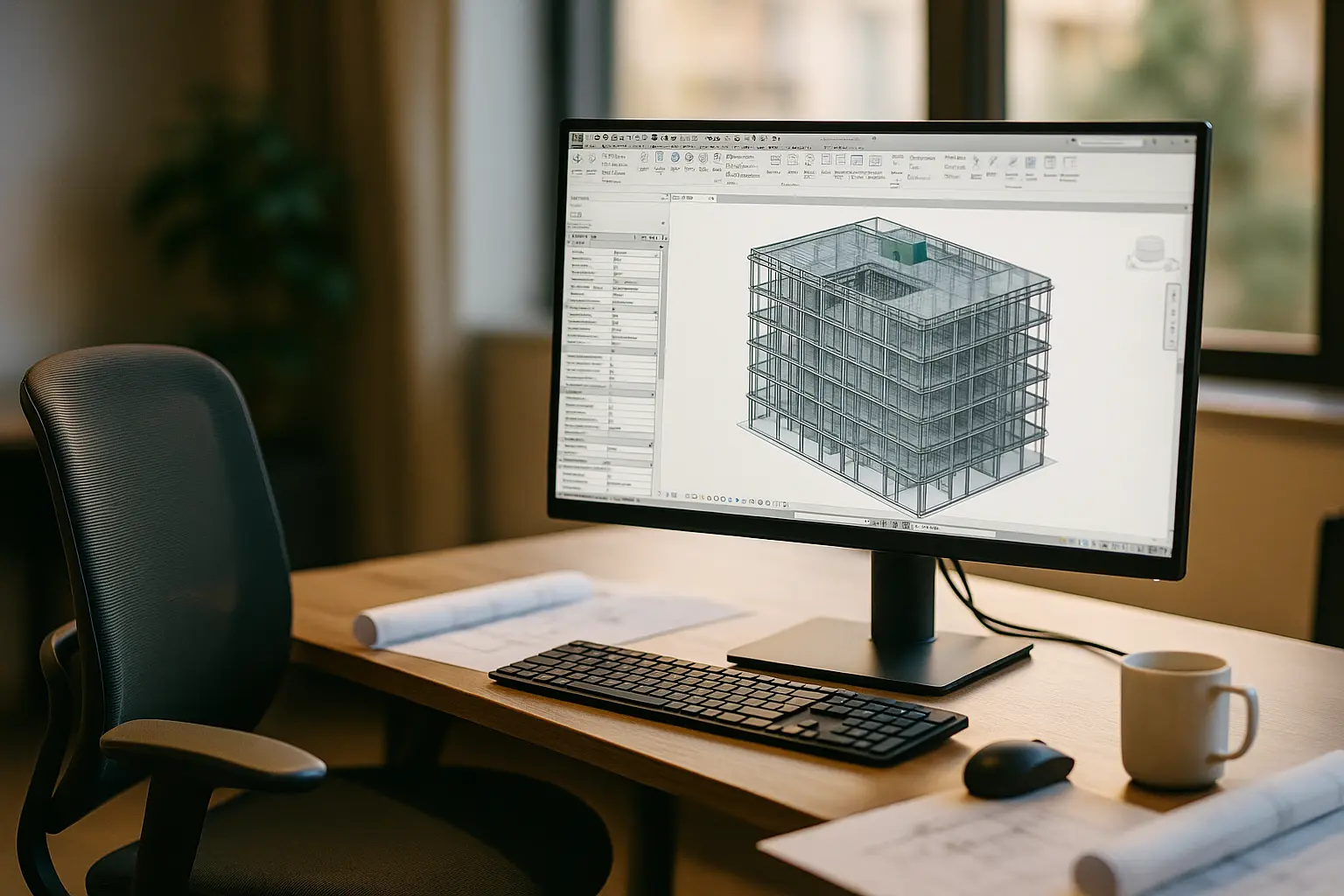
The most common question about BIM software used to be subscription or perpetual licence. As of 2026 that question no longer exists for the two platforms most architectural practices actually shortlist, which changes how the comparison should be run.
The four decisions that matter
- Perpetual licences are gone from the mainstream platforms, so budget for a recurring cost per seat, indefinitely.
- US list prices sit broadly between USD 2,400 and USD 3,700 per seat per year, before tax and before regional variation.
- IFC exchange quality decides whether you can work on a public project, more often than any feature does.
- ISO 19650 is under revision, with a draft issued in March 2026 and publication expected in 2027.
The licensing question answered itself
Graphisoft closed the perpetual route in stages: new customers lost the option at the end of 2024, existing licence holders at the end of 2025, and from 2026 Archicad is available on subscription only. Autodesk had already moved Revit to named-user subscription some years earlier, and no perpetual Revit licence is sold today.
The practical consequence for a practice is a change in accounting rather than in software. There is no longer a version you own and can keep running on an old workstation between projects. Every seat is an annual commitment, and every seat that lapses stops opening files it created. That reality belongs in a fee proposal, particularly for firms whose workload is uneven across the year.
Published prices, and what they omit
Figures below are United States list prices in US dollars, consulted in August 2026, excluding tax. Prices differ by billing country, and educational, network and volume arrangements are negotiated separately.
| Product | Monthly | Annual, per seat | Positioning |
|---|---|---|---|
| Autodesk Revit | USD 380 | USD 3,005 | Default in large multidisciplinary teams |
| Autodesk AEC Collection | USD 460 | USD 3,675 | Bundles Revit with AutoCAD, Navisworks and others |
| Graphisoft Archicad Studio | USD 201 | USD 2,414 | Individual architects and co-located teams |
| Graphisoft Archicad Collaborate | USD 237 | USD 2,840 | Adds MEP and cloud-hosted BIMcloud teamwork |
| Bentley OpenBuildings Designer | Not published | Quoted per organisation | Large infrastructure and asset-heavy portfolios |
What the table cannot show is the part that usually costs more than the licence. Migrating a template library, rewriting standard details, retraining staff and losing productivity during the changeover are real line items, and they are why practices tolerate a tool they grumble about rather than switch. Which competences to build first is a separate question, covered in our piece on digital tools training for construction teams.
The features that genuinely separate these tools
Every platform on the shortlist models in three dimensions, schedules quantities and detects clashes, so the marketing feature lists have converged. Three things still differentiate them in daily use.
Exchange quality is the first. IFC, the open file format maintained by buildingSMART, is how a model moves between a practice using Archicad and an engineer using Revit. How cleanly geometry and property sets survive that round trip varies by version and by discipline, and it is the single most useful thing to test on a real project file before signing anything.
Multi-user working is the second, and the models differ. Revit’s worksharing and Archicad’s BIMcloud teamwork solve the same problem with different assumptions about network and hosting. Discipline coverage is the third: whether structural and MEP modelling sit inside the same licence or arrive as a separate purchase changes the annual figure considerably for a multidisciplinary team.
The mandate usually decides more than the feature list
For anyone working on public projects, the requirement arrives from procurement rather than from preference. In the United Kingdom, publicly funded projects apply the UK BIM Framework and BS EN ISO 19650-2:2018 regardless of project type or size.
Germany runs a more explicit staircase. The Masterplan BIM für Bundesbauten, published in September 2021 by the federal interior and defence ministries, made Level I mandatory for newly planned federal building projects from the end of 2022 and Level II mandatory from 2023 for very large projects above EUR 50 million, extending to projects from EUR 0.5 million in 2025, with Level III reaching that same threshold in 2027.
ISO 19650 is being rewritten, and the vocabulary is changing
The standard that underpins those mandates is itself in revision. Draft International Standard versions of ISO 19650 parts 1 and 2 went out for public consultation on 10 March 2026, with part 3 following, and the final revised standard is expected in 2027. The 2018 editions remain in force until then.
Two proposed changes matter commercially. The delivery phase and the operational phase, currently separate parts, are drawn together into a single continuous information management cycle. And the language shifts away from BIM towards information management, reframing the discipline around the information an asset needs across its whole life rather than around the model produced during design. Anyone signing a multi-year software commitment this year should read that as a signal about where deliverables are heading.
Questions that come up during selection
Is the AEC Collection better value than Revit alone?
Only if the bundled applications get used. At USD 3,675 against USD 3,005 per seat per year, the bundle costs around 22% more and makes sense where teams genuinely run coordination and visualisation tools alongside the model. Where they do not, it is an expensive convenience.
Are there credible free or open-source options?
Yes, and they are viable for specific tasks rather than as a whole practice platform. Free IFC viewers and model checkers are widely used even in offices standardised on commercial software, because reviewing a model does not require a modelling licence.
Does subscription pricing mean losing access to old projects?
Effectively, yes, if the subscription lapses. This is the strongest practical argument for archiving completed projects in IFC alongside the native file, so a record remains readable without an active licence.
How much should a first BIM project budget for training?
Published figures vary too widely to quote responsibly. What is consistent across practices is that the first project on a new platform runs slower than the last one on the old, and pricing a job as though it will not is where BIM adoption most often goes wrong financially.
Start with the method, not the licence
The software choice only makes sense once the underlying method and its deliverables are clear.
Published 11 July 2025. Updated 8 August 2026. Sources: Autodesk published subscription pricing, consulted August 2026; Graphisoft published subscription pricing, consulted August 2026; Masterplan BIM für Bundesbauten, BMI and BMVg, September 2021; UK BIM Framework and BS EN ISO 19650-2:2018; ISO 19650 revision, Draft International Standard released for consultation 10 March 2026.