
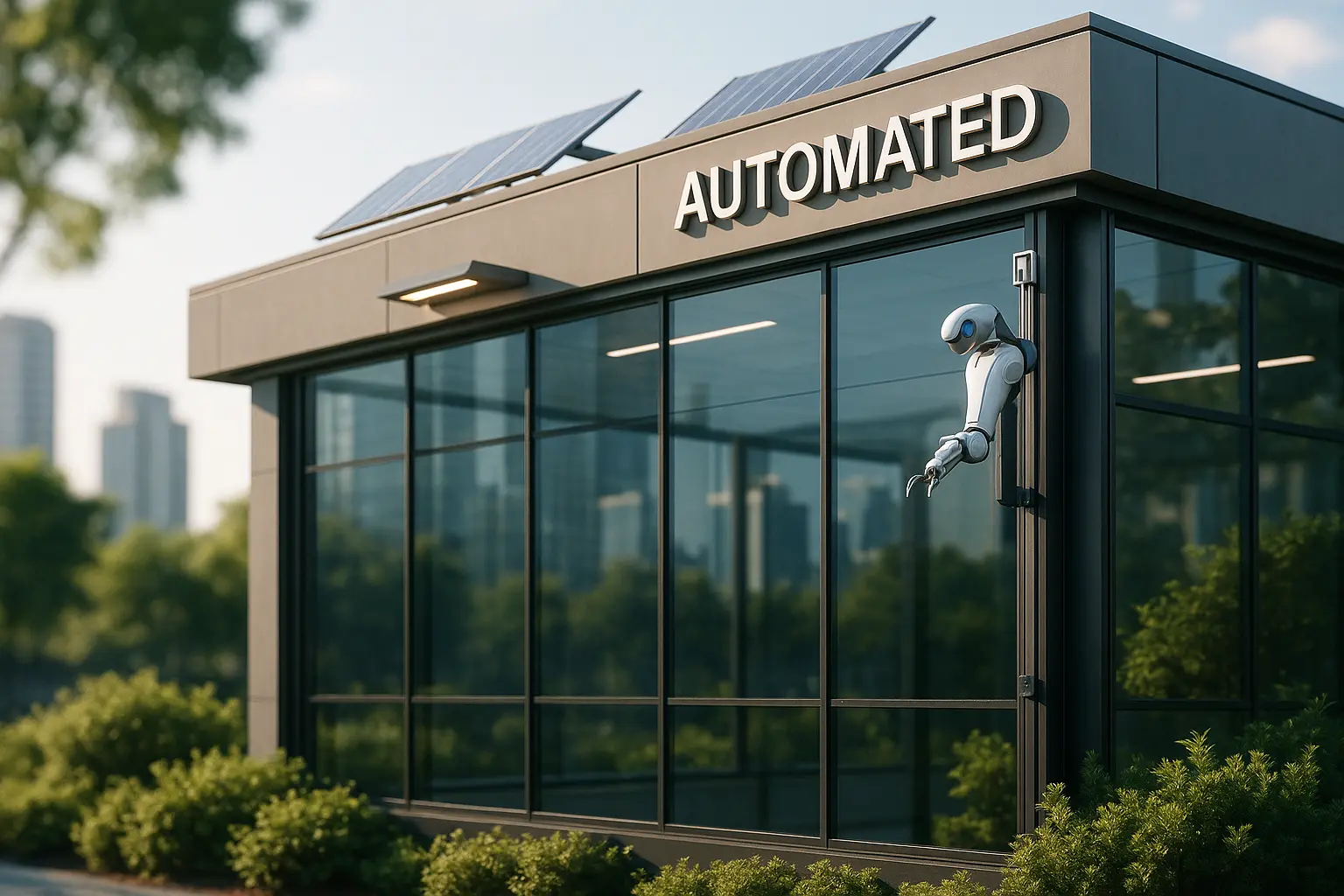
Automated building systems are usually presented as something arriving. They have in fact been arriving for sixty years, in overlapping waves, and the reason a modern retrofit is difficult is that most large buildings still contain two or three of those waves running at once.
The essentials
- Four technical generations are still in service simultaneously, which is the main integration problem on any retrofit.
- Directive (EU) 2024/1275 required systems in non-residential buildings above 290 kW by 31 December 2024, dropping to 70 kW from 31 December 2029.
- Indoor environmental quality monitoring was added to the functions such systems must provide.
- The security exposure is real and documented, and it is usually created by remote access left open for a contractor.
Four generations, all still on site somewhere
Understanding what is installed in an existing building is easier through its control generations than through vendor names.
- Pneumatic control. Compressed air driving dampers and valves, tuned by hand. Robust, entirely local, still occasionally found behind a ceiling in older stock.
- Direct digital control. From the 1980s, microprocessor controllers replaced pneumatic logic and made sequences programmable. This is the generation that created the modern job description of the controls engineer.
- Networked and IP-based control. Open protocols, above all BACnet, let equipment from different manufacturers share a network and a supervisory layer. Buildings stopped being collections of independent plant.
- Analytics on top. The current wave adds fault detection, energy benchmarking and remote diagnostics over the same control layer, without necessarily replacing any of it.
The fourth generation is where the market attention sits, but it is worth being clear that it is an addition rather than a replacement. Analytics need the third generation underneath them to have anything to read, which is why buildings running on generation two get quoted for a controls upgrade before anyone mentions dashboards.
What European law now requires
The recast Energy Performance of Buildings Directive, Directive (EU) 2024/1275, moved automation from good practice to obligation for larger non-residential buildings. Its Article 13 required systems in buildings with an effective rated output above 290 kW for heating, air conditioning or the combined systems with ventilation by 31 December 2024, and lowers that threshold to 70 kW from 31 December 2029. Transposition into national law varies by member state, so the applicable text is always the national one.
The directive also specifies what the system has to be capable of doing rather than merely existing: continuously monitoring, logging, analysing and allowing adjustment of energy use, benchmarking the building’s energy performance, detecting losses in the efficiency of technical building systems, and informing the person responsible for the facilities. The functional list was extended to include indoor environmental quality monitoring, which quietly turns air quality from an amenity into a measured output.
The 2029 step is the one to plan for now. Dropping from 290 kW to 70 kW brings a very large population of mid-sized offices, schools and retail units into scope, and the specialist labour to fit them out is not elastic.
The exposure that comes with the network
Connecting plant to a network creates a risk category that facilities teams were never staffed for, and the sector has a well documented example. In October 2021 an office building in Germany lost its automation system to an attacker who reached the network over the internet, then used a legitimate feature of the KNX protocol against it: unloading the devices and setting the protective key so that no engineer could reload them. Around three quarters of several hundred devices were left inoperable, covering lighting, motion detection and shutter control, and the building was run from manual circuit breakers for weeks. The case was documented by the security firm Limes Security, which reported further incidents in the years that followed.
Nothing exotic was required. The recurring weakness in these incidents is a remote access route opened so that an integrator could support the system without driving to site, then never closed, never segmented from the rest of the network and never covered by anyone’s patching schedule.
The mitigations are unglamorous and well established: separate the controls network from the corporate one, replace shared engineering credentials with named accounts, put contractor remote access behind a gateway that can be switched off, and keep an inventory of every device that can be reached from outside the building. None of that is exotic security work. It is asset management applied to a category of asset that has historically escaped it.
Retrofit or replace
For an existing building the decision usually turns on three questions rather than on the age of the system. Does the mechanical plant have useful life left, since a control upgrade on plant due for renewal is money spent twice? Does documentation exist, meaning point lists, sequences and as-built drawings, because reverse-engineering an undocumented installation is where retrofit budgets go missing? And is the existing network reachable and open enough to sit under a supervisory layer, or does it terminate in a proprietary dead end?
Where the answers are favourable, a supervisory and analytics layer over existing controls is normally the better economics. Where they are not, staged replacement by plant area beats a single overhaul, and it keeps the building operating. The cost side of that arithmetic, including the parts that are routinely underestimated, is set out in our analysis of what automation does to construction costs.
The rise of automated building systems is at this point less a technology story than a maintenance and governance one. The equipment works. What determines whether a building benefits is whether someone owns the system, reads what it reports and keeps the door to it shut.
Want the wider picture?
Building operation is only one of three distinct layers where automation is reshaping the built environment, each at a different stage of maturity.