
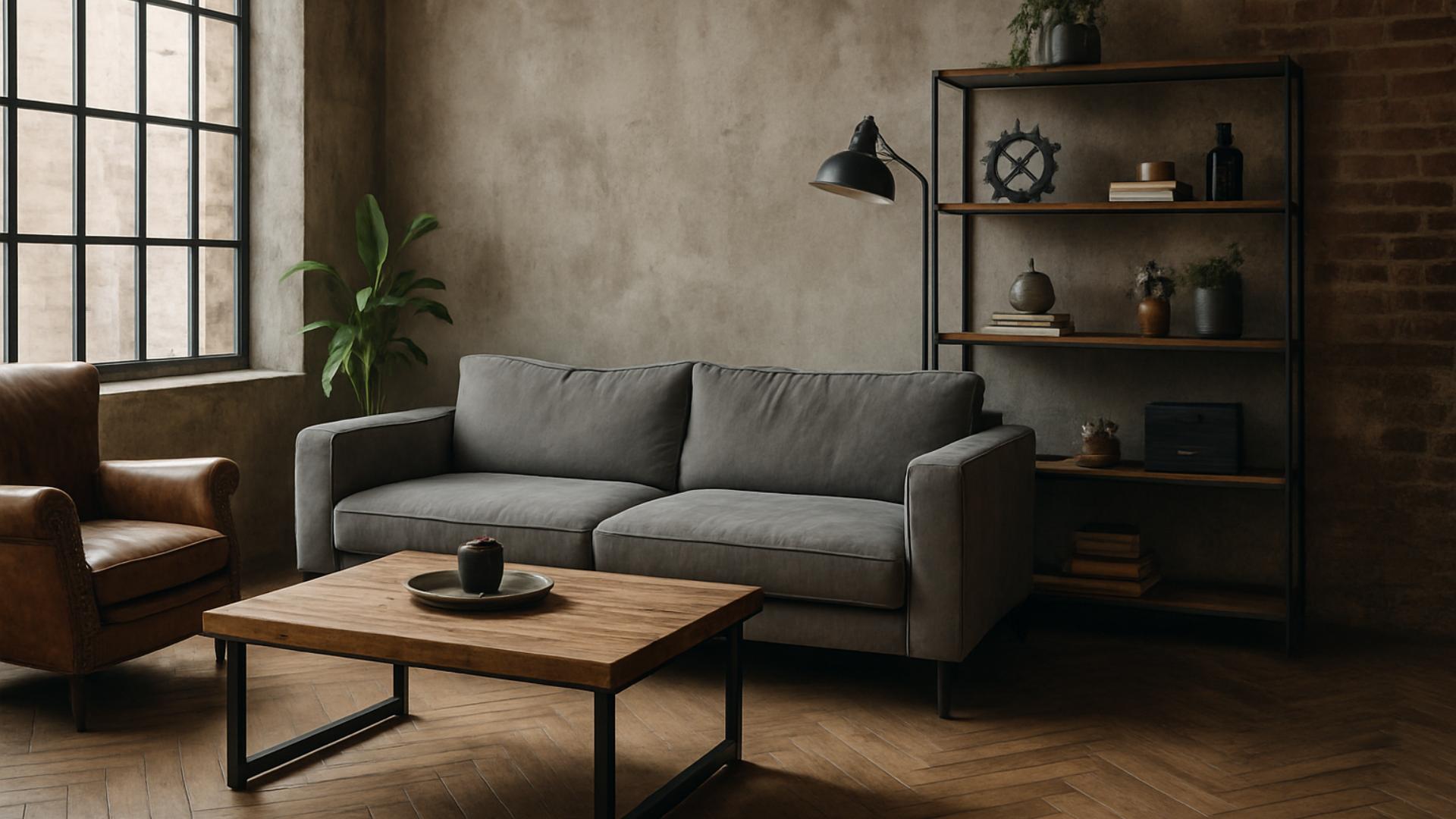
Industrial chic is one of the few interior styles with genuine rules, because it started as a set of constraints rather than a mood board. Warehouse conversions looked the way they did for structural reasons. Ignore those reasons and the result is a theme bar; respect them and the style still works forty years on.
The five rules
- One raw surface per plane. Brick or concrete or steel, not all three in the same sight line.
- Match every hard surface with a soft one, for sound before appearance.
- Metal earns its place by looking structural, never decorative.
- Light across the texture, not down onto the floor.
- Solve warmth and acoustics at design stage, not with cushions afterwards.
Rule one: one raw surface per plane
Choose a single raw material for each plane of the room and let the others stay quiet. Exposed brick on one wall, plaster on the rest. A concrete floor under painted walls. Steel at the windows, timber everywhere else. The eye reads one raw element as a decision and three as neglect.
The original lofts obeyed this by accident, since the brick was the wall and the concrete was the slab, and nobody added a third material for effect. The failure mode is easy to picture: brick wall, concrete floor, exposed ductwork, steel shelving and a distressed metal table in one room, at which point nothing reads as special because everything is competing. Restraint is what makes the raw material legible. If you want the full material vocabulary and where each one belongs, our guide to a warmer industrial interior works through it in more depth.
Rule two: every hard surface gets a soft answer
This is an acoustic rule before it is a decorative one, and it is the rule most often discovered too late. Brick, concrete, glass and bare timber all reflect sound, and a room made mostly of them holds onto noise: speech becomes tiring, music smears, and everyone talks slightly louder without knowing why.
Acoustic guidance for domestic listening spaces generally puts a comfortable reverberation time in the region of 0.4 to 0.6 seconds. A hard-surfaced open-plan room routinely sits well above that. The fix is surface area of absorption, applied to the largest reflectors first: the ceiling, then the walls, then the floor. A large rug with a dense underlay, full-height curtains even where privacy is not needed, an upholstered sofa rather than a leather one, and open bookshelves, which scatter sound rather than absorbing it, all count.
The decorative dividend is real. Textile is also what stops the palette reading as cold, so the rule pays twice.
Rule three: metal must look like it is doing a job
Steel and iron belong in this style because they were load-bearing. That is the test to apply to every metal element: does it look as though it holds something up, spans something, or connects two things? A steel-framed internal window passes. A blackened bracket carrying a real shelf passes. A metal cage bolted over a bulb that hangs from a plastic ceiling rose does not, because it is a costume rather than a component.
Two practical consequences follow. Metal elements should be fewer and larger rather than numerous and small, since scale is what reads as structural. And finish matters: powder-coated black, raw mild steel with a clear lacquer, and honest galvanised all behave like materials, while thin distressed paint effects on light gauge steel behave like props. Genuine reclaimed pieces work well here, and they carry a wear pattern nobody can imitate convincingly.
Rule four: light across the texture, not down onto the floor
Flat overhead light is the fastest way to kill an industrial interior. Brick, concrete and raw timber are surfaces whose entire appeal is relief, and relief only exists when light arrives at an angle. Wall washers, track heads angled onto masonry, uplights at the base of a brick pier and low-mounted pendants over a table all produce the grazing light that makes texture visible. A single central ceiling fitting flattens everything it touches.
One point of specification honesty. The bare filament bulb is inseparable from this style visually, but the original article is largely gone from the European market: Commission Regulation (EU) 2019/2020, the single lighting regulation, applies from 1 September 2021 and set minimum efficiency requirements that most halogen and incandescent light sources cannot meet. What is sold today as a filament bulb is almost always a filament-effect LED. The good ones are convincing, dimmable and warm, and the poor ones flicker and shift colour as they dim, so a dimmable lamp from a manufacturer that publishes its data is worth the extra outlay.
Rule five: comfort is designed in, not corrected afterwards
Exposed masonry means removing the plaster, and often whatever insulation and airtightness sat with it. Bare concrete underfoot is a large cold mass unless it is heated. Tall volumes stratify, holding the warm air at the ceiling while the room stays cool at seated height. None of these are reasons to avoid the style, and all of them are reasons to decide early rather than to fight later with rugs and throws.
The workable answers are structural. Insulate on the outside of an external wall wherever the property allows it, so the inside face can stay exposed. If you cannot, expose an internal wall instead and leave the external ones performing their job, which is usually the better trade in a house rather than a warehouse. Put underfloor heating under a concrete slab, where the thermal mass becomes an advantage instead of a complaint. Use ceiling fans set to winter mode in tall rooms to push warm air back down. Comfort decisions belong on the drawings, alongside the material choices, because they are far more expensive to retrofit.
The five rules against their failure modes
| Rule | The test to apply | What happens when it is broken |
|---|---|---|
| One raw surface per plane | Count the raw materials in one sight line. More than one is a warning | The room reads as unfinished rather than deliberate |
| Hard surfaces answered by soft | Clap once in the empty room and listen to the tail | Long reverberation, tiring conversation, a space nobody lingers in |
| Metal that looks structural | Ask what each metal element carries or connects | Themed decoration that dates within a few years |
| Light across the texture | Switch on at dusk and look for shadow on the masonry | Flat, grey rooms in which expensive materials look cheap |
| Comfort designed in | Sit in the room in February before deciding anything | A handsome space that is quietly unpleasant to occupy |
Questions readers put to us
Can the five rules work in a small modern flat?
Yes, and the first rule does most of the work. In a small room, one raw plane is the entire budget: a single brick or microcement wall, or steel-framed glazing to a hallway, with everything else calm. The style suffers far more from crowding than from lack of space.
Is exposing brick always a good idea?
No. Internal brickwork was often never meant to be seen and can be soft, patchy or built from poor-quality units, and exposing an external wall removes plaster that was contributing to its performance. Take a small area of plaster off and look before committing to the whole wall.
Does industrial chic work alongside other styles?
It combines well with mid-century and Scandinavian furniture, both of which supply the timber warmth the style needs. It sits badly beside ornate or highly decorated pieces, because the ornament argues with the premise that everything visible is doing something.
How do I stop the palette feeling grim?
Through material rather than paint. Leather, wool, aged oak, brass and living plants introduce warmth without breaking the discipline, whereas a bright accent colour tends to look pasted on. Keep colour in the objects and the palette in the surfaces.
Five rules, five tests, five predictable failures. Apply them at the point of deciding rather than at the point of decorating, and the result behaves like architecture instead of a look.
Want the whole style, not just the rules?
Our longer guide covers where the look came from, which materials belong to it and how to apply it in a home that was never a warehouse.